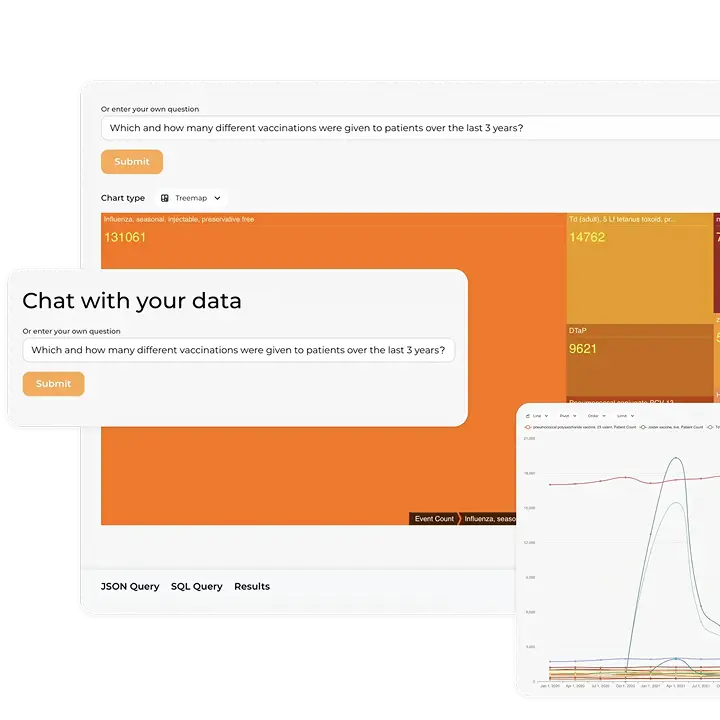
Healthcare organizations collect vast amounts of clinical data: encounters, diagnoses, procedures, medications, observations, and claims. Yet they rarely see how these events connect across a patient’s journey.
Kodjin Analytics addresses this gap with a dedicated Pathway Analysis capability built into its healthcare-native data platform. By reconstructing clinical event sequences across patient journeys, Pathway Analysis transforms fragmented records into queryable pathways, showing how patients move through care pathways, where journeys diverge, and where organizations can improve outcomes, efficiency, and decision-making.
Why Healthcare Data Still Fails Decision-Makers
Healthcare organizations sit on enormous volumes of data, but it is scattered across EHRs, billing systems, legacy platforms, and departmental databases. Clinical data lives in one silo, financial data in another, and operational data elsewhere.
People who need answers often cannot get them, or they wait weeks for reports that are outdated by the time they arrive. When data is difficult to access, decisions are made on intuition rather than evidence.
It also limits the value healthcare organizations can get from AI, because intelligent tools need governed, high-quality data at the core. As AI adoption accelerates, this foundation matters even more: the AMA reported that 81% of physicians use AI professionally in 2026, more than double the share reported in 2023.
Kodjin Analytics: A Healthcare-Native Data Foundation Built to Address This Gap
Kodjin Analytics is a healthcare-native data management platform that brings fragmented clinical, financial, and operational data into a unified foundation for analytics, interoperability, AI adoption, and healthcare application development.
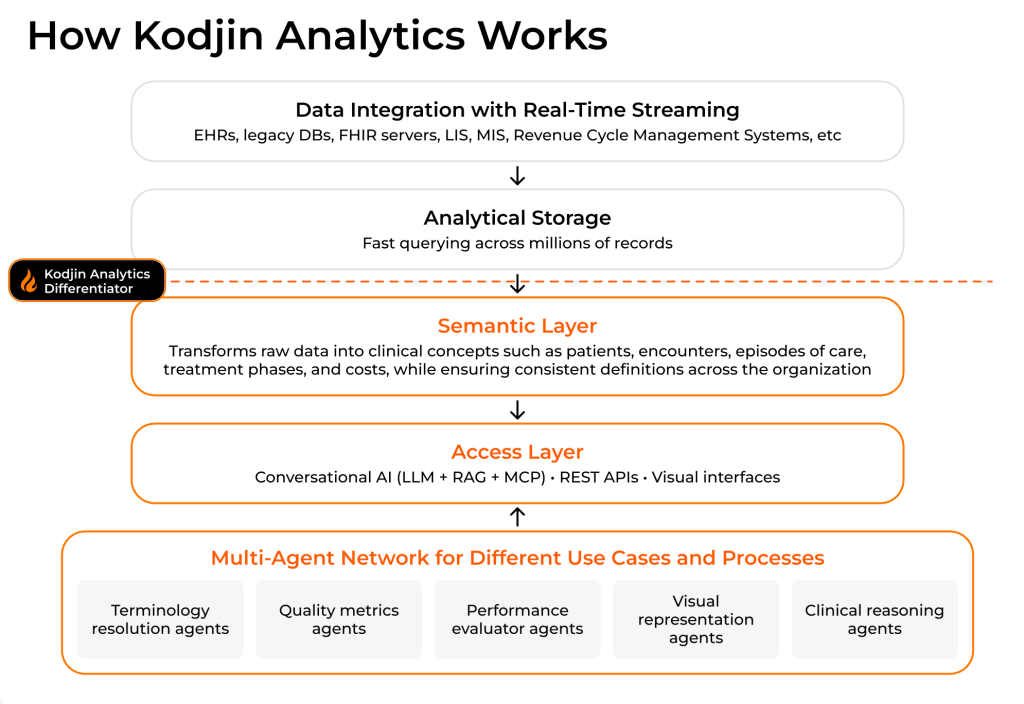
The platform is built around three core capabilities.
Consolidate. Kodjin Analytics connects to multiple data sources, including EHRs, billing systems, and legacy platforms, without requiring rip-and-replace migration. Data is automatically transformed, validated, and streamed in real time into a unified, structured foundation, so new records can be integrated and enriched as they arrive.
Analyze. The analytical suite is built for organization-wide adoption with minimal friction. Teams can work with self-service analytics, AI-assisted natural-language querying with immediate answers, embedded dashboards, cohort building, temporal queries, and Pathway Analysis without depending on SQL for every new question.
Build. Kodjin Analytics serves as a foundation for data products, new applications, workflows, and AI/ML initiatives. Its API-first, headless BI approach allows insights and analytical capabilities to be embedded into external tools or systems.
Unlike general-purpose BI tools adapted for healthcare, Kodjin Analytics is built to understand the clinical meaning and relationships within healthcare data. Kodjin FHIR® Server structures data in the HL7 FHIR® format, supporting interoperability and consistent data exchange. The platform also supports clinical terminologies such as SNOMED CT, LOINC, and ICD, with security and auditability built into the data layer.
The semantic intelligence layer translates complex database structures into a unified, queryable model. This layer supports visual analytics, conversational analytics, dashboards, embedded analytics, and open APIs.
Kodjin Analytics is built on more than ten years of Edenlab’s experience in healthcare IT, including the development of a national Health Information Exchange connecting 10,000 providers and serving 40 million patients, powering Elation, one of the leading U.S. EHRs, with a FHIR data platform, and earning ONC and Gematik certifications for the Kodjin FHIR Server.
Why Pathway Analysis Matters
Traditional healthcare analytics answers questions about what happened: how many patients were diagnosed, which procedures were performed, or how long patients stayed. Healthcare pathway analysis adds the missing sequence, showing how patients moved from one event to the next.
These are important questions, but they miss a critical dimension: the sequence.
Patient journeys are not isolated events. They are connected sequences of diagnoses, treatments, observations, and outcomes. Pathway Analysis helps healthcare organizations understand not only what happened, but how it happened.
Consider a cohort of patients identified as having a normal pregnancy. Some progress smoothly to childbirth. Others may experience complications that lead to miscarriage, premature birth, cesarean section, or induced termination of pregnancy. Aggregate counts may show how many patients reached each outcome, but not how they got there.
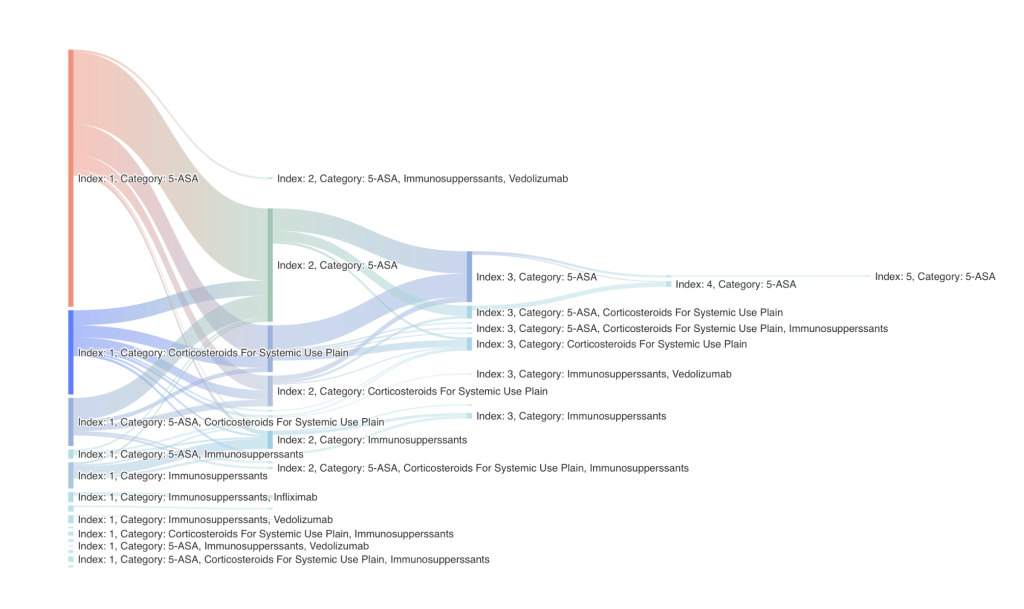
Pathway Analysis reconstructs the ordered sequence of clinical, operational, and financial events for each patient, then aligns those sequences across the population to show how patients actually move through care.
Clinical reality is sequential. A diagnosis leads to treatment, treatment produces an outcome, and follow-up may reveal a complication. Understanding these chains gives organizations a clearer basis for improving care, operations, and resource planning.
How Pathway Analysis Works in Kodjin Analytics
The Pathway Analysis module runs on the platform’s unified event data layer. It reconstructs patient journeys by identifying relevant clinical events, ordering them over time, and turning them into queryable pathways that can be analyzed across patient populations.
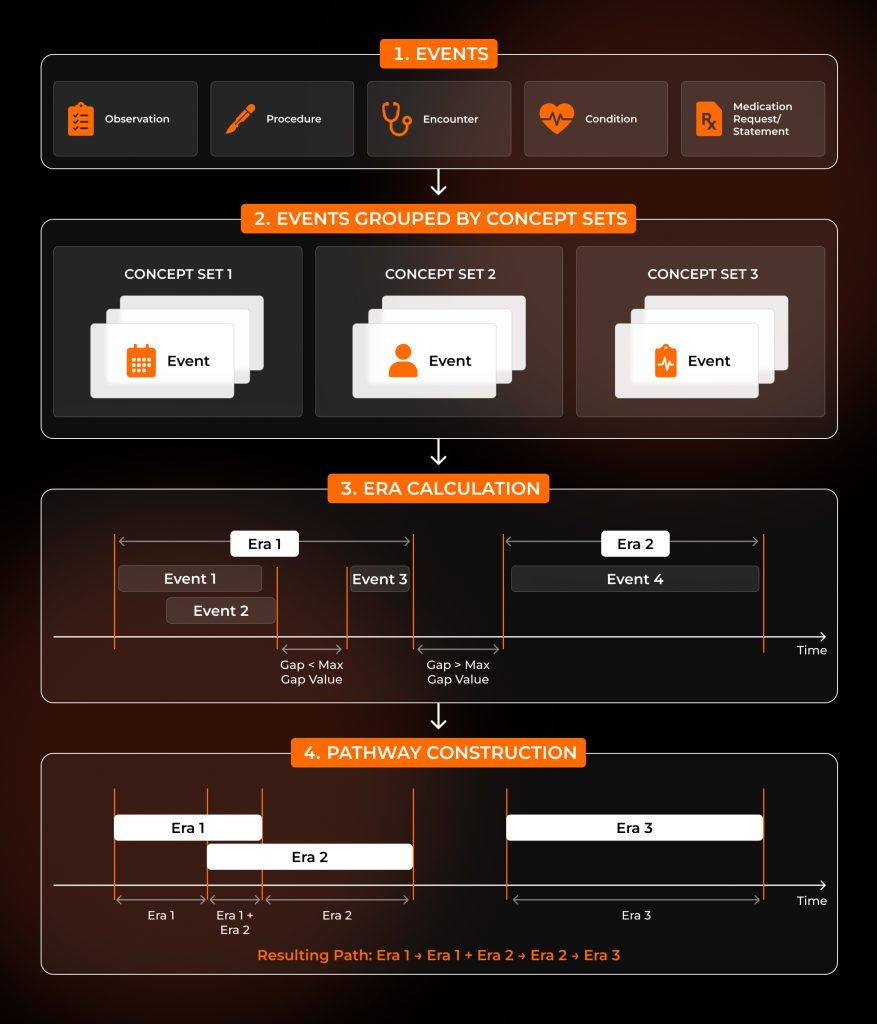
The system draws from a consolidated event store that brings together data from multiple FHIR resource types, including Condition, Procedure, Encounter, Observation, Immunization, MedicationAdministration, MedicationRequest, and Claim.
Users define which events should be included in the analysis by filtering by resource type, clinical codes, location, practitioner, time period, or clinical value. For each patient, qualifying events are ordered chronologically, turning separate records into a timeline.
These timelines are then combined into a pathway view. For example, a patient’s path might show “Normal pregnancy → Childbirth” or “Normal pregnancy → Miscarriage in the first trimester.” Once created, pathways become part of the analytical model, allowing users to group, filter, and count patients by the sequence of events they experienced.
The model identifies previous and next events for each step in a patient’s sequence. This enables transition-level analysis, helping users see which events most commonly follow a specific diagnosis or what typically precedes a complication.
Users can define an initial event as the starting point and a target event as the outcome of interest. These anchors help answer questions such as: among patients whose journey began with a normal pregnancy finding, what paths led to childbirth, and what paths diverged toward other outcomes?
The primary measure is the count of distinct patients at each step and along each path. This allows analysts to quantify patient flow, identify common pathways, rare variants, drop-off points, and outcome frequencies.
Visual Pathway Analysis Without SQL Dependency
Pathway Analysis is available through Kodjin Analytics’ visual query builder, a no-code interface that allows users to select measures, dimensions, and filters from the semantic model.
To configure a pathway analysis, users work with three main controls: Events to Include, Initial Event, and Target Event. In a pregnancy outcomes analysis, a user might include Normal pregnancy, Childbirth, Cesarean section, Premature birth, Miscarriage, and Induced termination of pregnancy. Selecting “Normal pregnancy” anchors the cohort. Selecting “Childbirth” as the target event shows which pathways led to childbirth and which diverged toward other outcomes.
Results are displayed as a Sankey-style flow diagram, where each vertical band represents a pathway step and the width of each flow reflects the number of patients moving from one event to the next. Results can be exported as CSV, with query logic available for validation.
What Healthcare Teams Can Use It For
Pathway Analysis in Kodjin Analytics supports analytical needs across clinical, operational, financial, and research domains.
Clinical quality improvement. By visualizing the actual routes patients take through care, clinical pathway analysis helps quality teams identify unwarranted variation, spot deviations from clinical guidelines, and measure how often patients reach expected outcomes versus complications.
Care pathway standardization. Organizations implementing standardized clinical pathways can use the analysis to establish a baseline of current practice, identify common paths and outliers, and measure whether standardization efforts are changing care delivery over time.
Outcome prediction and risk stratification. By studying early pathway steps that lead to adverse outcomes, clinical teams can identify warning signals and recurring patterns associated with higher risk. This turns retrospective pathway analysis into a foundation for earlier intervention.
Operational bottleneck identification. When combined with timing data, pathway analysis shows not only where patients go, but how long each transition takes. Prolonged intervals may indicate scheduling delays, referral backlogs, capacity constraints, or process gaps.
Comparative effectiveness research. Researchers can compare treatment sequences across patient subgroups, providers, or facilities to explore which pathways are associated with better outcomes, fewer readmissions, and other measurable differences.
Financial impact analysis. Different care pathways carry different cost profiles. By linking pathway analysis with financial data, organizations can quantify the financial impact of pathway variation and give finance and leadership teams a clearer view of cost drivers.
Regulatory reporting and compliance. Many quality measures and reporting requirements depend on whether specific care events occurred in the expected sequence and within defined timeframes. Pathway Analysis helps monitor these patterns, identify cases outside expected parameters, and support reporting with traceable, structured data.
What Makes This Different
Kodjin Analytics’ approach differs from traditional reporting tools, custom SQL workflows, and generic BI platforms. For organizations evaluating care pathway analytics software, this difference matters because pathway analysis depends on clinically structured data, semantic consistency, and the ability to reconstruct events across systems.
Because pathway analysis runs on clinically structured data, codes, terminologies, and relationships are preserved instead of being flattened into generic reporting tables.
Pathways are built from data consolidated across multiple source systems, allowing events from EHRs, surgical systems, laboratories, and other systems to be analyzed as one patient timeline.
The visual query builder puts pathway analysis in the hands of clinical and operational teams, not only data engineers. Domain experts can define events, adjust filters, test assumptions, and explore pathway views without waiting for every question to become a custom reporting request.
Every pathway analysis is backed by an inspectable SQL query and exportable results. At the same time, pathway dimensions and measures are managed in the semantic intelligence layer, where clinical concepts, metric definitions, access rules, and query logic stay consistent.
This also allows pathway analysis to work through AI-powered conversational analytics. A user can ask, “What are the most common pathways for patients diagnosed with heart failure?” and receive an answer grounded in the same governed model.
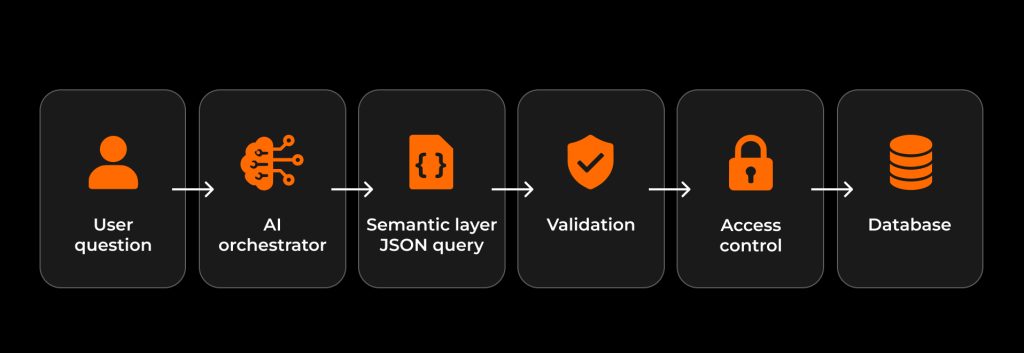
Pathway Analysis is protected by the same security and governance architecture as Kodjin Analytics, including privacy-by-design principles, alignment with HIPAA and GDPR requirementst, role-based access controls, encryption, audit trails, and governed API access. For LLM-powered conversational analytics, protected health information is not directly exposed to the LLM.
Explore our Conversational Healthcare Software
Learn more
Moving from Static Reports to Patient Journey Intelligence
Healthcare is inherently sequential. Patients do not experience isolated clinical events. They move through connected journeys of diagnoses, treatments, observations, and outcomes.
To improve care, reduce waste, and make better decisions, healthcare organizations need to understand not only what happened, but how it happened.
Kodjin Analytics makes these journeys visible, queryable, and actionable. With Pathway Analysis, organizations can reconstruct patient pathways, identify where journeys diverge, compare outcomes, detect bottlenecks, and understand the clinical, operational, and financial impact of different care routes.
The platform helps teams move beyond static reporting and start working with patient journeys as a source of real decision-making insight.