Industry: Healthcare
Country: US
Project type: Analytics Platform
Duration: Ongoing
Kodjin is an AI-powered data platform that helps healthcare organizations go beyond outreach, giving patients direct, personalized access to their health data. Patient engagement solution is a part of the broader Kodjin Analytics.
Designed for:
VPs of Patient Experience CMOs Heads of Digital Health Care Coordinators Marketing and Outreach TeamsMost patient engagement platforms are built around outreach. They send reminders, manage intake forms, and run screening campaigns. These are useful operational tools, but they stop at the transaction. Engagement becomes a set of tasks to complete rather than an ongoing interaction with the patient.
What’s missing is the other half:
The result: low portal adoption, shallow engagement, and patients who feel informed only when they’re in the exam room.
Kodjin gives organizations two capabilities that most patient engagement software solutions don’t offer: the ability to embed rich, personalized health insights directly into patient-facing portals and apps, and a foundation for building AI-powered engagement experiences.
With Kodjin, organizations can:
Most healthcare patient engagement solutions talk to patients. Kodjin embeds a knowledge layer into patient portals and apps, turning static health records into something patients can actually explore and understand themselves.
ONC/ASTP states that 65% of individuals accessed their patient portal. Yet, adoption rates among chronic disease patients, older adults, and underserved communities remain uneven. Portal usage is highest when providers actively encourage it and when the content feels relevant and actionable.
Kodjin transforms generic portals into personalized health companions. Instead of showing raw lab values, patients see their trends over time, get plain-language explanations, and receive contextual recommendations, powered by the same semantic layer that clinical teams use.
Stronger patient retention, higher satisfaction scores, reduced call center volume, and a portal people actually want to use.

Patient no-shows cost the U.S. healthcare system an estimated $150 billion annually, with average no-show rates ranging from 5.5% to 50% depending on setting and specialty. Patients with even a single no-show are 70% more likely not to return within 18 months.
Kodjin helps organizations identify patients at risk of disengagement by connecting appointment history, clinical context, and social determinants. Outreach teams can target the right patients with the right message at the right time, based on actual data.
Lower no-show rates, recovered revenue, better schedule density, and improved continuity of care for at-risk patients.

ONC research shows that while 99% of hospitals allow patients to view records online, fewer than half have implemented all advanced engagement capabilities by 2024. The tools exist, but the data behind them often lacks the context needed to drive action.
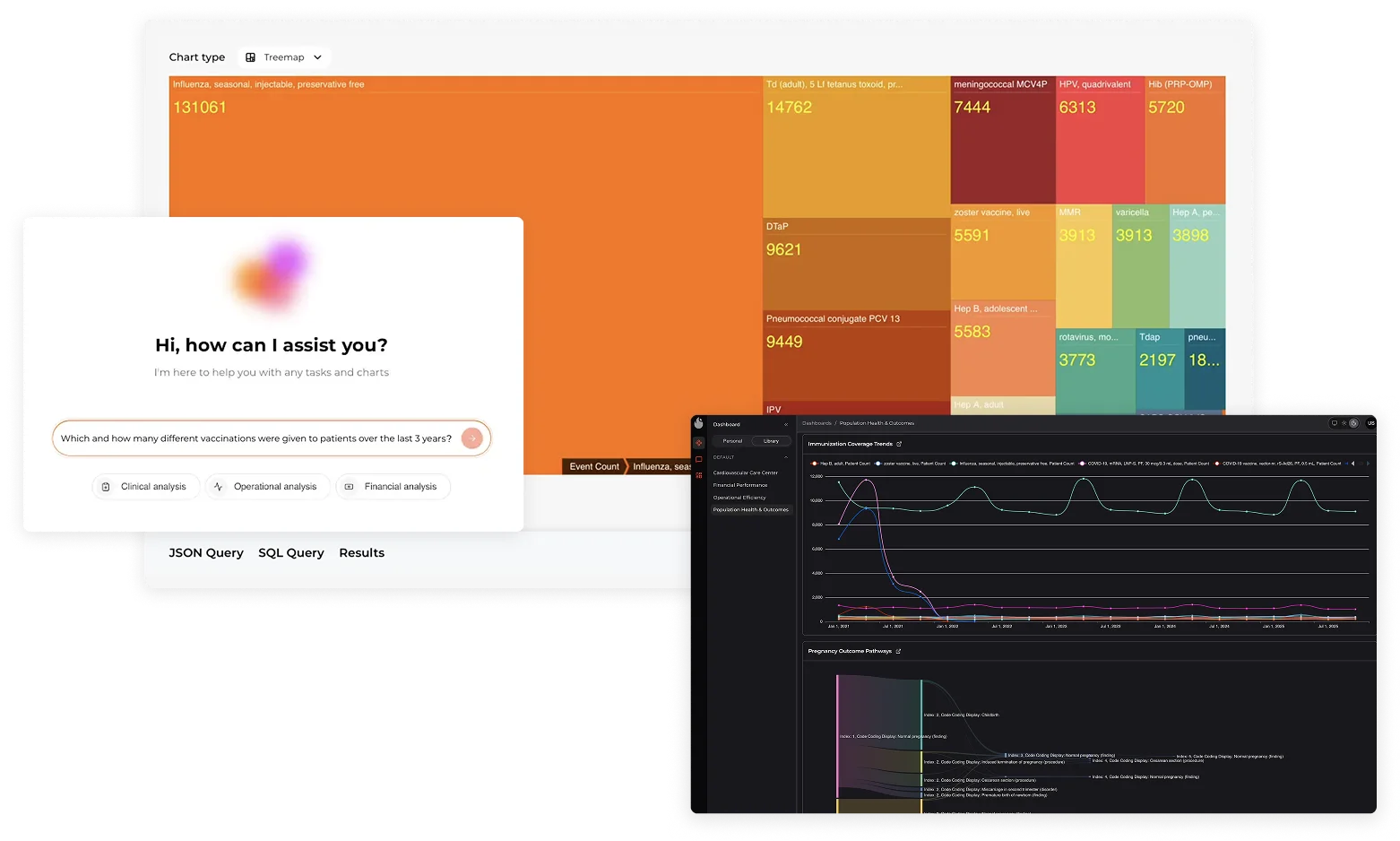
Kodjin identifies patients due for preventive services, mammograms, colonoscopies, and immunizations by querying live clinical data. Care teams can ask questions like “Which patients aged 50–75 are overdue for colorectal screening?” and launch targeted campaigns in minutes.
Higher screening completion, earlier disease detection, stronger quality measure performance, and better population health outcomes.

Research published in Frontiers in Communication found that patient portal adoption rates have remained between 37% and 54% for years, partly because portals don’t offer experiences that feel personal or useful enough to justify repeat visits.
Kodjin’s semantic layer and pre-built healthcare components let development teams create AI agents, chatbots, and personalized care assistants in weeks, not months. These agents operate on real patient data without requiring custom ML training or FHIR expertise.
Faster time to market for digital engagement features, lower development cost, and patient experiences that feel smart and personal from day one.

Higher portal engagement through personalized, meaningful content

Fewer missed appointments and better schedule utilization
Increased preventive screening rates through data-driven outreach
Faster development of AI-powered engagement experiences
Take a look at the patient engagement solution in a guided, live walkthrough tailored to your organization’s priorities.
Kodjin helps clinical, operational, and product teams access unified patient data without relying on analysts or navigating disconnected systems. The same foundation that powers patient-facing insights also supports internal outreach planning, care coordination, and quality improvement.


Transform your patient portal from a record viewer into a retention tool. With Kodjin, patients get personalized health insights, plain-language lab explanations, and proactive care recommendations, which drive higher satisfaction and stronger portal adoption.

Reach the right patients before care gaps widen. Kodjin connects clinical data to outreach, so screening campaigns, follow-up reminders, and adherence nudges are driven by real clinical signals. That means better preventive care coverage, higher quality scores, and stronger performance.

Embed rich health analytics into your patient portal, mobile app, or telehealth platform without building BI infrastructure. Kodjin’s semantic API delivers insights that any front-end can consume and supports building AI agents on top of pre-built components.

Identify which patients need follow-up, which are overdue for screenings, and where adherence is breaking down without manually pulling lists from multiple systems. Kodjin helps coordinators prioritize outreach based on live clinical data.

Run targeted campaigns based on real clinical criteria. Identify patients due for preventive services, track campaign performance, and segment audiences by condition, risk level, or engagement history.

Embed patient engagement capabilities directly into your product. Kodjin’s semantic API and pre-built healthcare components let EHR vendors and digital health platforms add personalized patient insights, AI-powered outreach, and self-service health data access.
Effective engagement requires connecting data that lives in different places: EHR records, appointment systems, patient-reported outcomes, portal activity, and screening histories. Kodjin’s semantic layer unifies these sources so that every engagement touchpoint, from a reminder text to an AI chatbot, operates on the same consistent, clinically meaningful data.
What Kodjin does
What it means for patient engagement
Unifies patient data from EHRs, portals, apps, and claims
One complete patient profile instead of fragmented views across disconnected systems
Structures data around clinical meaning
Digital patient engagement tools reference conditions, medications, and care history, not raw codes and table joins
Enables patient-facing analytics via API
Embed personalized health insights directly into portals and apps without building BI infrastructure
Supports AI agent development with pre-built components
Build chatbots, care assistants, and automated outreach on top of real patient data in weeks
Keeps metrics consistent across all channels
Whether a patient interacts via portal, text, or app, the engagement data feeds the same analytics layer
Processes data in near real time
Outreach, alerts, and patient-facing insights reflect current clinical status, not last month’s data extract
Supports FHIR-native interoperability
Data flows cleanly across systems, partners, and care settings without losing context
Patient engagement is just one of the ways organizations use Kodjin. The same data foundation supports care management, cost analysis, and research, so you’re not buying separate tools for each initiative.
Explore related use cases:
In most organizations, patient engagement software and analytics live in separate worlds. Outreach campaigns pull from one dataset. The portal shows patients something different. The analytics team works in its own silo and rarely sees engagement data in a clinical context.
The result is that nobody has a complete picture of what is actually happening with a given patient. Kodjin addresses this by putting clinical data, engagement activity, and patient experience metrics on a single semantic layer. Your automated campaigns, your patient portal, and your internal reports all draw from the same source. Teams stop reconciling conflicting numbers and start acting on a shared view.
They can, but the depth of that integration varies a lot. Most patient engagement platform products connect to EHRs through HL7 or limited FHIR support. Data comes in, but it tends to lose its clinical structure along the way. A diagnosis code ends up as just another field in a table.
Kodjin takes a different approach. It is FHIR-native at its core, so EHR integration preserves how conditions, medications, and encounters actually relate to each other. That clinical context is what makes it possible to power appointment reminders, personalized condition management insights, and meaningful content inside patient-facing apps. Without it, you are integrating data but not understanding it.
It is, and it should be. Kodjin’s headless API lets you embed patient engagement solutions directly into any telehealth platform. That means personalized health data, care recommendations, and screening reminders show up inside the virtual visit experience itself, not in a separate tool the patient has to find on their own.
It works across web, mobile, and app-based telehealth tools. As a patient engagement solution, Kodjin adapts to how your practice delivers care rather than requiring you to change your workflow around the software.
The best patient engagement software must be HIPAA-compliant at a minimum, with role-based access, encryption at rest and in transit, and comprehensive audit logging. Kodjin goes further with SMART on FHIR authorization, fine-grained permissions, and certifications, including ONC, Gematik, and GDPR compliance. This matters especially for patient engagement solutions for hospitals and health system deployments where security and data governance aren’t optional.
At a minimum, the best patient engagement software needs to be HIPAA-compliant, with role-based access, encryption at rest and in transit, and comprehensive audit logging. Kodjin goes further. It includes SMART on FHIR authorization, fine-grained permissions, and holds ONC, Gematik, and GDPR certifications. This matters especially for patient engagement solutions for hospitals and health system deployments, where security and data governance are not things you can treat as optional or bolt on later.
It depends on what your organization is trying to improve, but the most useful KPIs for healthcare patient engagement solutions tend to fall into three areas.
Clinical adherence: screening completion rates, medication adherence, and follow-up attendance.
Patient behavior: portal login frequency, session depth, no-show and cancellation rates, satisfaction scores.
And operational efficiency: how much of your patient intake and outreach is automated versus manual, and how long it takes your team to go from identifying a gap to launching a campaign.
Kodjin helps track all of this across the full healthcare ecosystem through dashboards, conversational queries, or embedded analytics, so teams do not have to wait for a quarterly report to know what is working.
Compliance starts with architecture, not checklists. Kodjin’s digital patient engagement tools are built on a FHIR-native core with role-based access, SMART on FHIR authorization, and full audit trails. The platform is HIPAA-compliant, GDPR-compliant, ONC-certified, and Gematik-certified. For value-based care organizations, this means engagement data is governed with the same rigor as clinical data.
Kodjin is built for handover, not dependency. After launch, your team maintains the patient engagement platform with low-code tools for deployment, ELT, and operations. We provide training, documentation, and knowledge transfer so you’re self-sufficient from day one. The platform is infrastructure-agnostic, cloud or on-premise, with minimal lock-in. And when you need custom development, from clinical trial patient engagement software features to specialized AI agents, we build on top of the same foundation.
Please leave your email to get Kodjin Analytics Solution Brief
We have sent a copy to your email
Please leave your email to get Kodjin Data Platform Solution Brief
We have sent a copy to your email
Back to website content