Industry: Healthcare
Country: US
Project type: Analytics Platform
Duration: Ongoing
AI-powered data platform for organizations that need to enhance their care management with trusted and accessible insights across population health, care transitions, and treatment pathways. Care management solution is a part of broader Kodjin Analytics.
Designed for:
Clinicians Managers Analysts Researchers PatientsMost care management software are designed to operationalize care. They provide risk stratification and patient identification, workflow management for care coordination and automation at scale. This makes them strong systems of execution.
But analytics inside these platforms is inherently constrained:
As a result teams act on what is already modelled, but struggle to explore beyond it. New use cases are slow to implement. Data doesn’t give you answers, it keeps you within predefined rules.
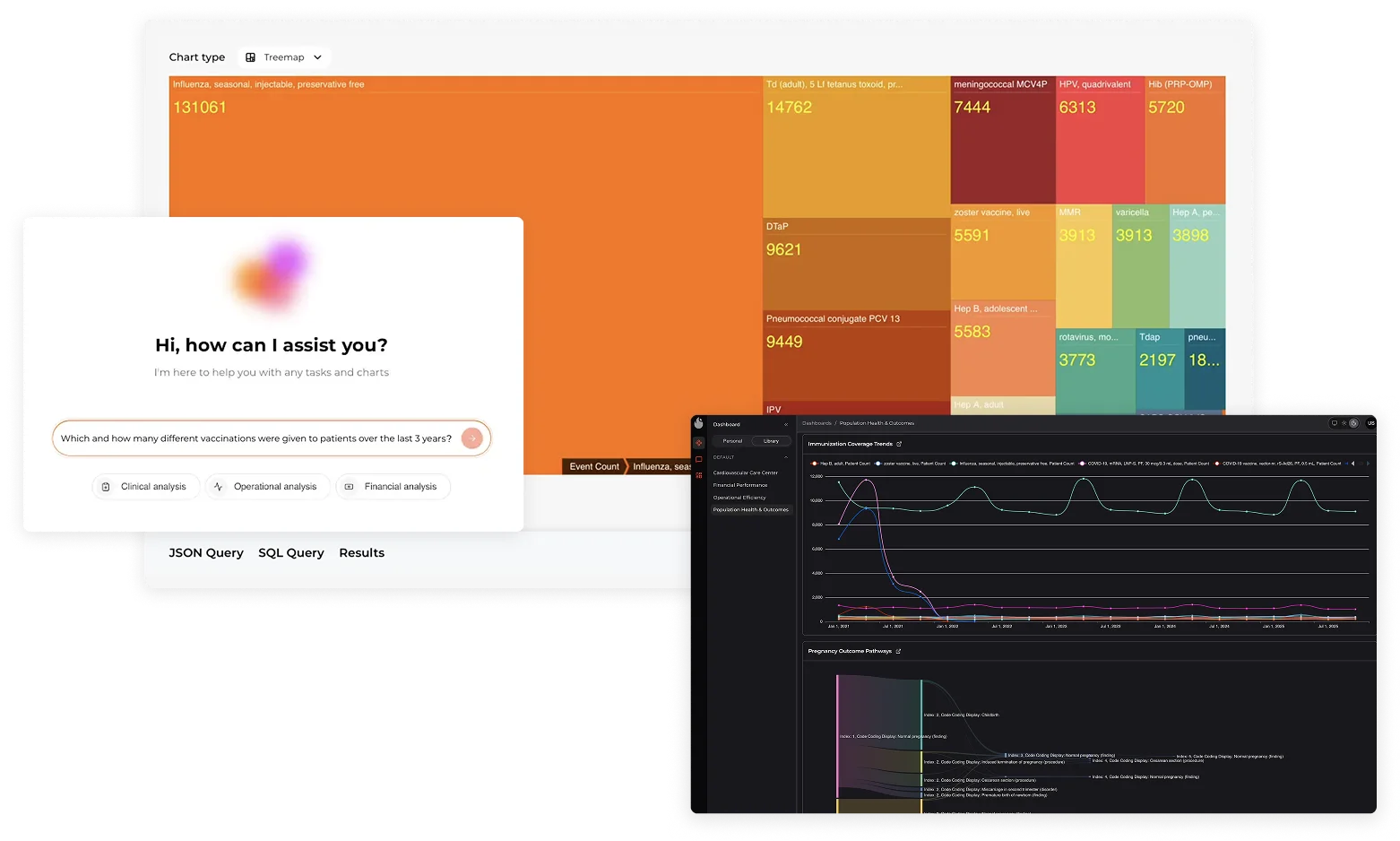
Kodjin Analytics helps organizations take a more proactive approach to care while making data-driven decision-making accessible.
It brings fragmented healthcare data into a single knowledge layer and lets teams flexibly explore it through AI-assisted question answering or visual query building.
With the Kodjin care management solution, organizations can:
Kodjin Analytics is a thinking layer that enables teams to quickly test hypotheses, combine different risk signals and ask questions directly against the data.

Get a clear, strategic view of where care gaps, variation, and avoidable risk are building, including patterns not captured in predefined reports. Kodjin helps CMOs connect population trends with clinical priorities and make earlier, better-informed decisions without relying on analysts.

Understand who needs attention beyond already flagged patients by existing models. See where interventions are working, where coordination breaks down, and uncover gaps that fall outside current programs. Kodjin gives a stronger, more flexible basis for prioritization.

Build more meaningful cohorts by exploring data beyond predefined segments. Combine clinical conditions, utilization, and social context to identify patterns and care gaps that standard models miss, enabling more precise and adaptive population health strategies.

See how care pathways actually perform, including variation and breakdowns that are not visible in standard reports. Kodjin helps leaders identify missed follow-ups, transition risks, and inconsistencies across the full patient journey.

Get a complete picture of each patient without navigating multiple systems or interpreting dashboards. Kodjin helps clinicians quickly understand what matters, surfacing relevant history, risks, and missed steps, and providing answers directly to their apps.

Track how care management programs perform and uncover operational bottlenecks beyond predefined patterns. Kodjin helps identify gaps in follow-up, and resource inefficiencies, including issues that old dashboards don’t surface.
CDC says 90% of the US’s $4.9 trillion in annual healthcare spending goes to people with chronic and mental health conditions.
Kodjin helps teams spot patients who are falling off track, missing important tests, or showing signs of rising risk across diabetes, COPD, heart failure, hypertension, and other chronic conditions.
Earlier intervention, stronger chronic disease control, lower avoidable utilization, and better use of care management resources.

CMS can penalise hospitals by reducing payments under the Hospital Readmissions Reduction Program.
Kodjin helps leaders identify patients at the highest post-discharge risk by combining utilization history, diagnoses, medication complexity, discharge patterns, and social context.
Fewer preventable readmissions, lower penalty exposure, and stronger coordination across acute, post-acute, and community settings.

CDC found that 59.4% of adults included in its SDOH module reported at least one adverse social determinant or related need.
Kodjin helps teams connect social and clinical signals, such as food insecurity, transportation barriers, missed appointments, and uncontrolled conditions, so interventions can be aimed where barriers to adherence are highest.
Smarter resource allocation, stronger health equity programs, and better support for risk adjustment and quality performance.

AHRQ reports that about 20% of patients experience adverse events within three weeks of discharge, 61% of which are preventable.
Kodjin helps organizations see where actual care pathways are drifting from intended protocols, where handoffs are breaking down, and where variation is quietly affecting outcomes.
More consistent care delivery, faster identification of what's actually working, and fewer losses tied to variation that could have been caught earlier.

15-25% fewer missed interventions in chronic disease management

15-30% reduction in readmissions and up to 3% revenue protected
3-5× faster identification of at-risk populations for targeted interventions
Up to 30% reduction in adverse events through care pathway optimization
Take a look at the care management analytics solution in a guided, live walkthrough tailored to your organization’s priorities.
Care management works better when insight is not limited to a small group of technical users. Kodjin helps democratize access to healthcare data so different teams can explore it in ways that best fit their work.

Kodjin Analytics is an AI-powered data management platform built specifically for healthcare. Its semantic layer turns raw data into meaningful clinical concepts and understands how they relate to each other. This foundation becomes a single source of clinical knowledge for analytics, operational, and automation applications.
What Kodjin does
What it means for your organization
Aggregates data from multiple systems
Regardless of the data source or data model (including FHIR), we create a unified, normalized, and interoperable foundation
Turns raw data into clinical concepts
Teams work with meaningful terms, not disconnected fields, codes, and tables
Understands relationships between concepts
Insights reflect real clinical context, such as how cardiac events relate to arrhythmias or heart failure
Makes data usable across tools and applications
Operational systems, care management tools, and custom apps can act on the same knowledge layer
Enables automation based on real clinical context
Workflows, alerts, and applications can operate on meaningful data instead of raw rules
Removes technical barriers to exploration
Users can ask questions in simple language through AI, query builder, APIs, or embedded tools
Makes insights more trustworthy
Reports, dashboards, applications, and automation stay aligned around one source of truth
Improves semantic interoperability
Organizations can preserve meaning across departments, partners, and care networks
Supports smoother care transitions
Shared context makes handoffs, coordination, and follow-up clearer across the patient journey
A care management tool is only one way to use Kodjin. The same healthcare analytics platform can support a wide range of clinical, operational, and research initiatives across your organization.
Explore related use cases:
Kodjin also works as the infrastructure behind broader data and AI initiatives. Alongside analytics, it can serve as a foundation for healthcare data exchange, compliance, and faster development of AI-powered applications.
Use Kodjin as a central platform to consolidate, normalize, validate, and exchange healthcare data across systems. It gives organizations a stronger foundation for interoperability, governance, and compliance without splitting data across disconnected tools.
Kodjin also helps teams build AI-powered healthcare applications faster. Its semantic layer exposes data in business and clinical terms, enabling LLM-based tools to work more naturally within the healthcare context. That makes it easier to create copilots, assistants, and other data-rich applications on top of reusable healthcare logic.
Usually, the same problems keep showing up in different forms. Care teams know some patients need closer follow-up, but finding them takes too much manual work. Analysts spend time pulling lists instead of answering harder questions. Leaders can see outcomes moving in the wrong direction, but not always why. That is often the point where care management software starts to make sense. It gives teams a more reliable way to connect the dots across risk, utilization, follow-up, and care gaps, rather than working with scattered reports and disconnected systems.
Health care case management software is often built around managing individual cases once someone is already identified and enrolled. Care management software usually needs to support a wider view. It helps organizations decide where to focus attention in the first place, how to define priority populations, and how to spot patterns across programs or sites. In that sense, a care management system supports both intervention and planning. It helps teams manage the work in front of them, but it also helps them understand where that work should start.
A care management tool should help people answer practical questions they face every day. Which patients are most likely to miss follow-up after discharge? Which chronic populations are quietly getting worse? Where are care plans stalling? Which programs use resources well, and which need a closer look? A mature care management solution should help teams explore those questions without waiting for a custom report every time. That is what moves it from passive reporting into something more useful operationally.
A good care management software vendor should bring more than technology. They should understand that healthcare organizations rarely need a clean-room implementation. Most already have established workflows, messy data, competing priorities, and different user groups with very different needs. A strong care management software company should be able to work within that reality, shape the platform around it, and help the organization build something sustainable. The most valuable care management software solutions tend to come from that kind of partnership, where implementation is treated as part of the solution.
It can, but only if the foundation is flexible enough. Provider care management solutions, payer workflows, and home-based care programs may look different on the surface, yet they often depend on the same core capabilities: shared patient context, clear cohort logic, and a way to understand what is happening over time. That is why some organizations look for a broader care management platform rather than separate point products. A home care payer management solution or home care management system tends to work better when it is connected to the same underlying data and logic as the rest of the care model. The same is true for home care management software solutions that need to support both coordination and oversight.
The best care coordination software should help teams see where care is drifting off course before the problem becomes expensive or hard to reverse. That might mean missed follow-up, poor transitions, inconsistent handoffs, or populations whose risk is changing faster than teams can respond. It should also make that picture easier to share across the organization. In practice, the best care coordination software is not the one with the most screens or the longest feature list. It is the one that helps people make better decisions sooner and stay aligned on the same view of the patient and the work.
Please leave your email to get Kodjin Analytics Solution Brief
We have sent a copy to your email
Please leave your email to get Kodjin Data Platform Solution Brief
We have sent a copy to your email
Back to website content