Industry: Healthcare
Country: US
Project type: Analytics Platform
Duration: Ongoing
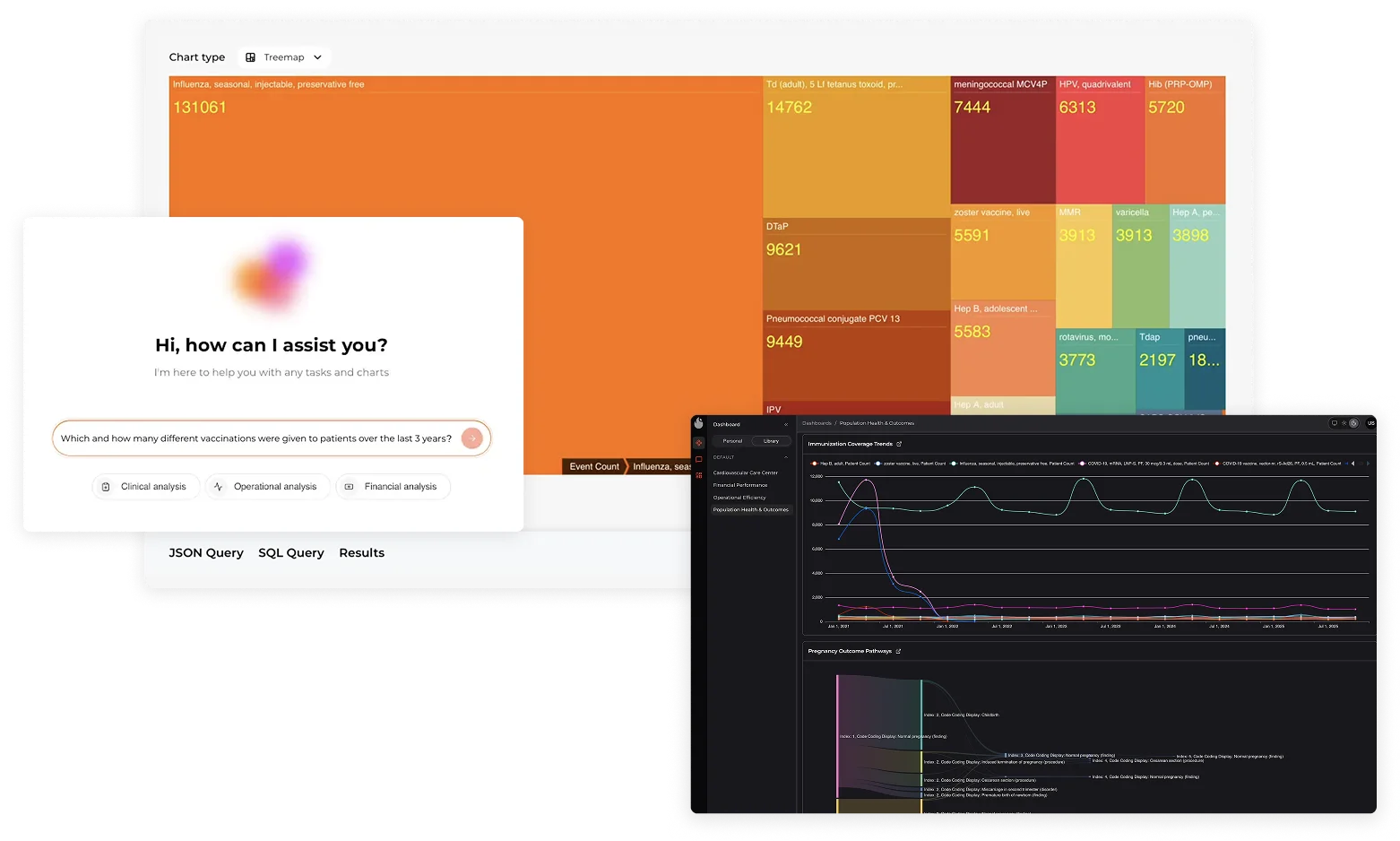
Kodjin is an AI-powered data platform that helps healthcare organizations connect clinical, financial, and operational data to make strategic financial decisions. Unify cost, revenue, and utilization data across systems and explore them through natural language or visual queries. Healthcare financial analytics is a part of broader Kodjin Analytics.
Designed for:
CFOs & CMOs Department Heads VP of Revenue Cycle Finance Analysts Claims & Risk ManagersHealthcare finance leaders operate at two levels. At the strategic level, they need to understand overall margin performance, cost drivers, and revenue trends across the organization. At the operational level, they rely on RCM analytics to track claims, billing workflows, and denial resolution. But most available tools serve only the tactical layer, answering narrow questions: Was this claim paid? Where’s the denial?
What these tools can’t do is let leaders explore financial data independently: test hypotheses, drill into cost drivers, or connect financial performance to clinical and operational reality.
Kodjin Analytics gives finance leaders the ability to explore financial data independently without waiting for analyst support or assembling data manually. Unlike solutions built on static data extracts, Kodjin Analytics works with real-time data, so insights reflect what’s happening now, not last quarter.
With Kodjin Analytics, decision makers can:
Kodjin Analytics tells you what’s happening with your business. By unifying clinical, financial, and operational data in a single knowledge layer, it gives healthcare leaders the cross-domain visibility they need to strategize.
Understand margin drivers across service lines, facilities, and payer contracts. Kodjin connects clinical, financial, and operational data so CFOs and department heads can pinpoint where costs are rising, where revenue is leaking, and where clinical variation is quietly affecting profitability across a single hospital or a multi-facility network.
Forecast medical loss ratios, analyze cost-per-member trends, and connect claims data to clinical and social context. Kodjin helps actuarial, contracting, and care management teams model risk exposure, evaluate network performance, and identify where targeted interventions will have the greatest impact on total cost of care.
Track shared savings, monitor cost-per-member trends, and connect quality metrics to total cost of care across value-based arrangements. Kodjin helps VBC leaders evaluate contract performance, model risk exposure, and identify which care pathway decisions are driving financial outcomes, so organizations can manage risk proactively, not retrospectively.

Explore the full financial picture independently without requesting reports or waiting for analyst support. Kodjin lets CFOs drill into cost trends by service line, test hypotheses about margin drivers, and connect financial performance to clinical context. Ask “Why did the cardiology margin drop last quarter?” and get an answer immediately, with the ability to explore further.

Go beyond tracking denial rates. Kodjin helps RCM leaders see how denial patterns connect to treatment strategies and payer-specific behavior, so you can fix root causes upstream instead of chasing individual claims after the fact. Connect revenue cycle performance to the clinical and operational context that drives it.

Understand how clinical decisions affect the bottom line. Kodjin helps CMOs see where treatment variation, prescribing patterns, and care pathway choices are driving cost differences, enabling productive conversations with finance grounded in shared, cross-domain data rather than separate reports that never quite align.

Track profitability against volume, acuity, and clinical outcomes. Kodjin helps service line leaders identify which procedures and programs drive margin and which are quietly eroding it, with enough clinical context to know whether the issue is operational, clinical, or contractual.

Negotiate from evidence, not estimates. Kodjin lets contracting teams analyze cost-per-episode by provider and payer, compare reimbursement rates against actual cost of care, and model the financial impact of proposed contract terms, building data-driven positions for every renewal and renegotiation.

Spend less time assembling data, more time analyzing it. Kodjin’s semantic layer eliminates manual joins across billing, clinical, and operational systems. Analysts can explore cost variation, revenue trends, and utilization patterns through natural language or visual queries, focusing on insight instead of data engineering.
According to Kaufman Hall/Fierce Healthcare, the median hospital operating margin was 1.3% for full-year 2025. While margins were stronger than in the immediate post-pandemic period, hospitals continue to face headwinds from rising costs, eroding payer mix, and growing bad debt, leaving little room for strategic missteps.
Kodjin helps finance leaders understand exactly where margin is being made or lost by service line, payer, provider, and patient population. By connecting cost data to clinical context, organizations can identify which operational decisions are driving financial results and which are quietly eroding them.
Sharper financial planning, evidence-based resource allocation, and strategic decisions grounded in cross-domain data.

AHA estimates that hospitals spent $43 billion in 2025 trying to collect payments insurers owe for care already delivered. Denial management alone costs $18 billion, with prior authorization, documentation requests, and appeals pulling resources away from patient care.
Kodjin helps organizations see denial patterns in clinical context, connecting denial reasons to documentation gaps, coding variation, and payer-specific behavior. Instead of chasing individual claims, teams can fix the upstream issues that cause revenue leakage in the first place.
Lower denial rates, faster collections, and reduced administrative costs of revenue recovery.

A recent AHA/Vizient analysis found that 36% of hospital cost growth came from treating more patients, 19% from higher patient acuity, and 45% from rising per-patient costs, including labor, supplies, and drugs.
Kodjin helps organizations untangle these cost drivers. Finance and clinical teams can analyze cost variation by episode, provider, and treatment pathway, seeing where spending is clinically justified and where it reflects inefficiency. This turns healthcare cost management from a back-office function into a shared strategic conversation.
Targeted cost reduction, stronger clinical-financial alignment, and the ability to distinguish necessary spending from waste.

According to the Advisory Board, margin pressure in 2026 is more intense than at any point in the last decade. With payers tightening rate negotiations, hospitals can no longer offset rising costs through higher commercial allowable rates alone.
Kodjin helps organizations connect population health performance to financial outcomes, tracking shared savings, modeling risk exposure, and monitoring cost-per-member trends across value-based arrangements. Leaders can see how quality metrics and care pathway decisions affect total cost of care, identify high-risk cohorts driving spend, and evaluate whether VBC contracts are performing as modeled.
Stronger contract negotiations, better risk forecasting, clearer visibility into total cost of care, and tighter alignment between clinical quality and financial sustainability.

Strategic Visibility Into the Margin Driver

Reduced Revenue Leakage and Denial Exposure
Better Cost Control Through Clinical-Financial Alignment
Stronger Positioning in Value-Based Contracts
Take a look at the medical cost analysis solution in a guided, live walkthrough tailored to your organization’s priorities.
Financial strategy shouldn’t live in spreadsheets that only the finance team can access. Kodjin helps clinical leaders, department heads, and executives explore financial data alongside clinical and operational context independently, without analyst support.

Traditional financial tools work with billing and claims data in isolation. But the questions that matter most – “Why are costs rising in this service line?”, “Is this payer contract actually profitable?”, “Where is clinical variation driving unnecessary spend?” – requires connecting financial data to the clinical and operational context. That’s what Kodjin’s semantic layer does.
What Kodjin Does
What it Means for Your Organization
Unifies financial, clinical, and operational data
Cost, revenue, and utilization data live alongside clinical outcomes, patient acuity, and care patterns in one queryable layer
Structures data around business and clinical meaning
Teams work with concepts like “cost per episode” or “margin by service line”
Enables natural language financial exploration
CFOs and department heads ask questions in plain language, get answers immediately, and drill deeper on their own
Connects cost drivers to clinical decisions
See how treatment variation, prescribing patterns, and care pathways affect cost
Supports real-time and batch data ingestion
Financial insights reflect current reality, not last quarter’s data extract
Keeps metrics consistent across teams
Finance, clinical, and operations teams share the same definitions and the same source of truth
Connects value-based care performance to financial outcomes
Track shared savings, monitor risk exposure, and evaluate whether quality benchmarks translate into expected financial returns across all VBC arrangements
Supports FHIR-native interoperability
Financial data flows cleanly alongside clinical data across systems, payers, and partners
Connects value-based care performance to financial outcomes
Organizations managing risk-based contracts can track shared savings, monitor cost-per-member trends, and evaluate whether quality benchmarks translate into expected financial returns
Financial analytics is one of the most powerful ways to use Kodjin, but the same platform supports clinical, operational, and research analytics on the same data foundation.
Explore related use cases:
Strategic financial management requires clean data flowing between billing, clinical, and operational systems. Kodjin supports the full data lifecycle from ingestion to AI-powered exploration.
Financial analytics depends on consistent, validated data from across the organization. Kodjin consolidates billing, clinical, and administrative data into a unified foundation, ensuring that financial insights are trustworthy and complete.
Build AI-powered financial applications, cost forecasting tools, margin alerts, contract performance dashboards, on top of Kodjin’s semantic layer, using pre-built healthcare components and any LLM provider.
The first question to ask is whether the tool you’re evaluating is really a healthcare finance analytics solution or just RCM reporting with a nicer interface. A true healthcare financial analytics software should let you connect financial data to clinical and operational context, so you can answer strategic questions. Look for cross-domain data unification, natural language querying, and the flexibility to explore cost, revenue, and utilization across service lines, providers, and payer contracts. Kodjin delivers all of this on a FHIR-native, healthcare cost management foundation.
Yes. Kodjin is modular by design, so you assemble only the components you need for your specific use case. A midsize hospital focused on healthcare cost analytics and service line profitability doesn’t need to buy the same configuration as a large health system running a full financial planning & data analytics platform. That modularity keeps costs proportional to scope, and the platform’s low-code operational tools reduce ongoing maintenance overhead compared to traditional financial data management solutions.
Most denial management tools work at the claim level, flagging individual denials after they happen. Kodjin takes a different approach. As a healthcare cost analytics software, it connects denial patterns to clinical documentation quality, coding variation, and payer-specific behavior. When you can see that a particular procedure has a high denial rate tied to specific documentation gaps, you can fix the root cause rather than chasing each denial individually. This is the difference between a cost analysis tool and a strategic healthcare finance solutions platform.
It does by helping organizations understand the upstream causes. Kodjin’s medical cost analysis capabilities connect write-off patterns to patient demographics, payer behavior, service types, and clinical context. This helps finance teams identify which patient populations or services are driving bad debt and develop targeted strategies, whether that’s better upfront financial counseling, adjusted payment plans, or payer contract renegotiation. It’s a more strategic approach to healthcare cost management than simply tracking write-offs after the fact.
When financial data is weeks or months old, leaders are reacting to problems instead of preventing them. Kodjin’s financial data analytics software supports near-real-time data ingestion, so finance teams can monitor margin trends, revenue analysis, and cost performance as they develop. This is especially critical for financial data management solutions in organizations managing value-based contracts, where timely insight into cost-per-member and utilization trends directly affects financial performance.
Absolutely, and this is one of the areas where Kodjin’s cross-domain approach matters most. Value-based care requires understanding how clinical performance connects to financial outcomes. Kodjin brings population health data, utilization patterns, quality measures, and cost data into a single healthcare financial analytics layer. That means leaders can track shared savings, model risk exposure, and analyze cost-per-member trends alongside clinical quality, all in one place. It works as both a cost analysis tool and a strategic healthcare finance analytics solution for organizations moving toward risk-based payment models.
Please leave your email to get Kodjin Analytics Solution Brief
We have sent a copy to your email
Please leave your email to get Kodjin Data Platform Solution Brief
We have sent a copy to your email
Back to website content