HEDIS® performance is becoming a year-round operating concern for organizations responsible for quality outcomes. NCQA says more than 235 million people are enrolled in plans that report HEDIS results, and HEDIS includes more than 90 measures across six domains. Health plans remain the primary reporting audience, but the work behind HEDIS also involves payers, health insurers, managed care organizations, delegated provider groups, ACOs, MSOs, provider networks, and health technology vendors that support quality programs.
For many teams, the hard part is getting reliable evidence early enough to act. A screening may be documented in an EHR but absent from claims. A lab result may sit in a separate system. A follow-up visit may be recorded by a provider but remain invisible to the team responsible for quality performance. When this happens, teams spend time sorting real care gaps from missing data.
Traditional workflows tend to surface these problems late. Quality teams define eligible populations, review available data, request records, validate evidence, and prepare results for reporting. By then, there may be limited time to support providers or reach members and patients who still need care.
Digital HEDIS moves quality measurement toward structured, standards-based data that can be used more consistently across systems. Readiness starts before final measure calculation. It depends on whether clinical and administrative data can be collected, standardized, trusted, and used in daily quality operations.
Kodjin Analytics by Edenlab and the Kodjin interoperability stack help payers, provider organizations, and health technology teams build that working layer: FHIR®-based data preparation, terminology alignment, data quality validation, configurable quality indicators, care gap analytics, and performance monitoring before official reporting begins.
Explore our Advanced Healthcare Analytics Software
Learn more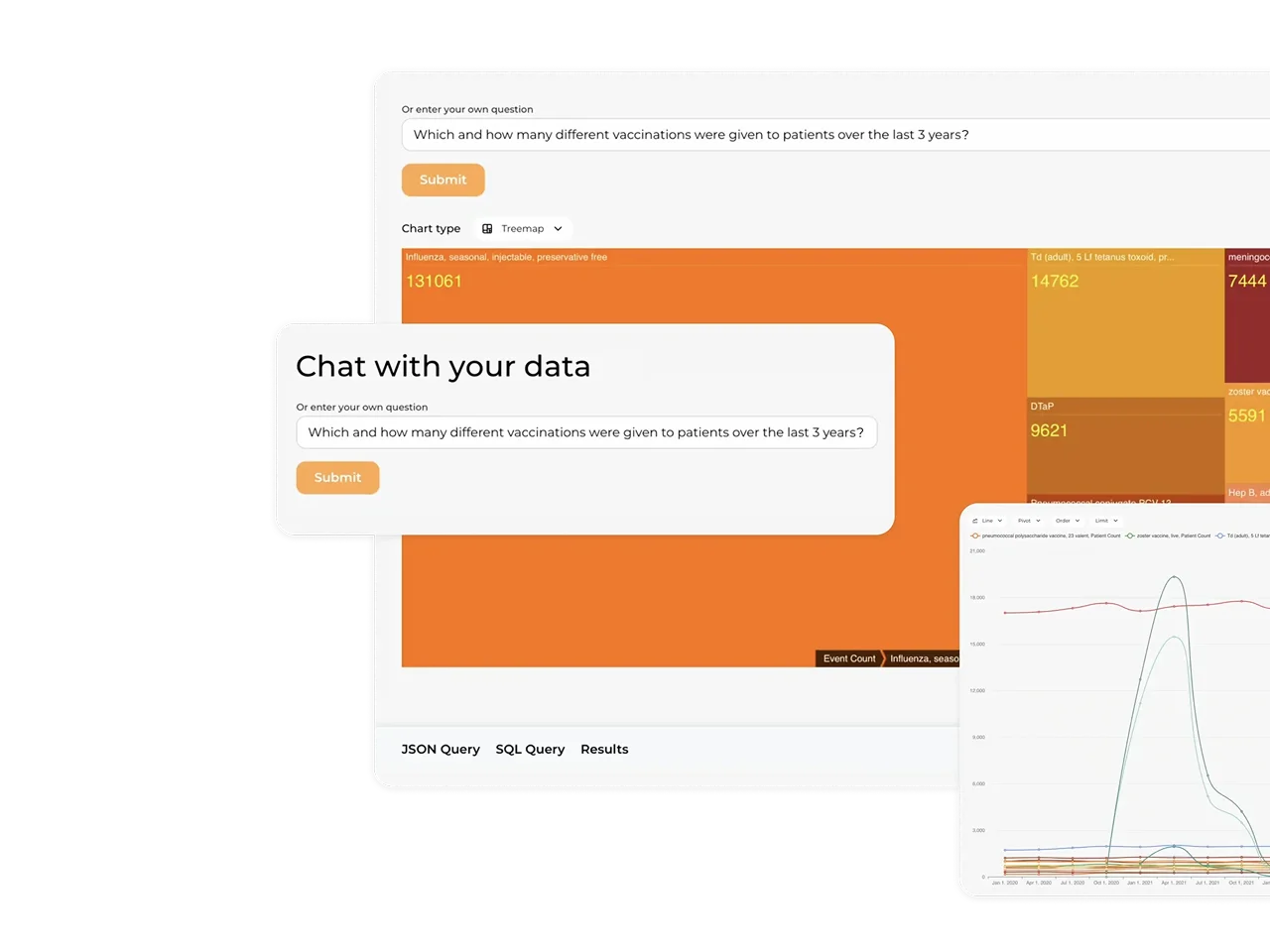
Key Takeaway: Kodjin does not replace certified HEDIS reporting workflows, reporting vendors, or measure logic. It strengthens the data and analytics layer around that workflow, so quality teams can see performance earlier, separate missing evidence from missing care, and act before gaps become final reporting outcomes. The certified engine computes the official rate at year-end; Kodjin manages the daily work that shapes what that rate will be.
From Annual Reporting to Operational Performance Management
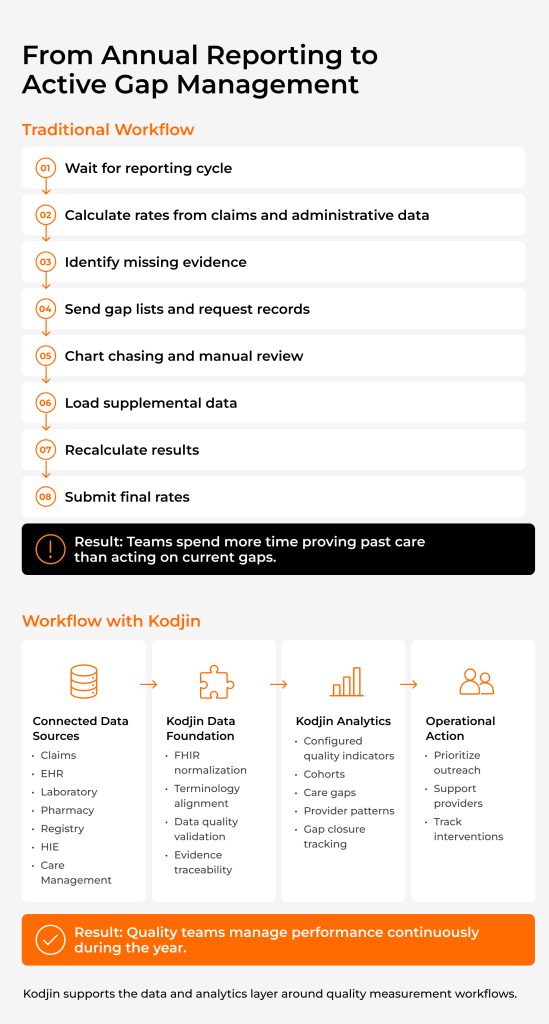
HEDIS still has a formal reporting cycle. Eligible populations need to be defined, evidence needs to be validated, rates need to be calculated, and results need to be prepared for submission. That process remains necessary, although the work that changes performance happens earlier. For many organizations, though, performance is still discovered rather than managed: rates arrive after the measurement year closes, when the only levers left are chart chase and supplemental data — activities that document care already delivered rather than causing care to happen.
A provider closes a screening gap. A member completes a follow-up visit. A lab result becomes available. A care management team identifies a patient before the gap becomes harder to close. If quality teams see these events near the end of the reporting cycle, they may still be able to document past care. They have less time to change what happens next.
The main barrier is evidence. Teams may know the measures and still lack a complete view of the member or patient journey. The reason is architectural: quality evidence is distributed across systems that were not designed around a common data model. Claims, EHR records, lab results, pharmacy data, registries, HIE feeds, and care management activity often reach the quality team at different times and in different formats.
Care Gap: the person still needs an action, such as a screening, test, medication review, or follow-up. In day-to-day operations, this becomes a care management gap when teams cannot clearly see who needs outreach, which action is still missing, or which gaps can still be closed before the performance period ends.
Data Gap: the action may already have happened, but the organization responsible for quality performance cannot see or prove it yet. This is often a healthcare data management gap: the evidence may sit in a provider EHR, lab system, pharmacy feed, registry, HIE, or care management platform, but it is not connected, standardized, or visible to the quality team.
Treating both gaps the same wastes time. Teams may contact members who already received care, request records providers have already documented, or miss patients who need intervention because the relevant data is late or incomplete. The distinction also changes the next action: one case may require member outreach, while the other may require better evidence capture from a provider, lab, registry, or connected system.
NCQA’s Digital HEDIS direction points toward interoperability, automation, and more timely insight. Its ECDS reporting standard gives health plans a way to collect and report electronic clinical data for HEDIS quality measurement and improvement. NCQA’s HEDIS Implementation Guide makes the preparation layer more concrete by showing how clinical and administrative data should be sourced and prepared in FHIR for digital quality measures. NCQA is phasing out hybrid measurement in favor of digital quality measures computed from structured electronic data — a shift that rewards organizations whose data is structured, terminology-mapped, and complete, and penalizes those whose data quality leaves earned numerator hits on the table.
Official HEDIS calculation and submission still require the appropriate NCQA licensing, validation, and reporting workflow. NCQA’s Measure Certification program says health plans submitting HEDIS measure rates must certify their measure logic directly or use an NCQA-certified vendor.
The operational opportunity sits before that final reporting step. With the required data available, organizations can track HEDIS-relevant, Stars-relevant, or contract-specific indicators during the year. Because connected source feeds stream updates rather than arriving in periodic batches, the measurement picture stays current: when a screening result lands, the compliance picture changes that day, and when a discharge is recorded, the follow-up clock starts immediately.
When source feeds are connected and updated continuously, this tracking can move closer to near-real-time quality operations. Teams can identify members or patients at risk of becoming a care gap, intervene earlier, and track whether the gap was prevented or closed.
Where HEDIS Automation Creates Value
The most useful automation happens before official calculation and submission. It helps quality teams prepare evidence, understand where gaps exist, and act while performance can still change.
ECDS shows why this work can be approached by measure area rather than measure by measure. NCQA lists ECDS measures in areas such as behavioral health, preventive screening, immunizations, and chronic condition management. Many of these measures depend on the same data patterns: clinical events, claims, observations, medications, procedures, encounters, attribution, and evidence provenance.

The same foundation can support multiple measure areas because the work repeats. Source data has to be mapped, normalized, checked, and connected to the person, provider, event, and time period involved. Once that layer is standardized and traceable, quality teams can monitor different gaps and cohorts without rebuilding the data logic from the beginning each time.
How Kodjin Supports HEDIS and Quality Performance Operations
Kodjin Analytics is a FHIR-native healthcare analytics platform for teams that need to turn fragmented clinical, administrative, and operational data into usable intelligence. The platform is designed for healthcare-specific analytics, cohort logic, dashboards, and natural-language exploration over governed data.
Kodjin Analytics does not ship as a prebuilt NCQA HEDIS measure library. Instead, it builds on the fact that every HEDIS measure decomposes into the same anatomy: an eligible population, qualifying numerator events, exclusions, and temporal constraints. When the required data and measure definitions are available, each component becomes a governed, reusable cohort or metric in the platform’s semantic layer — one definition shared by every dashboard, query, and API consumer — and the underlying logic is inspectable, so an analyst can verify exactly why a member appears on, or drops off, a gap list.
Kodjin Suite: The FHIR Data Layer
These components are the interoperability foundation Kodjin Analytics stands on: they handle the continuous ingestion, transformation, validation, and terminology normalization that keep the analytical picture current and unified.
Kodjin FHIR Server processes, validates, and stores healthcare data through a FHIR-compliant RESTful API. Its dynamic profiling capability can support validation against implementation guide packages and custom profiles, which is relevant for organizations preparing data against HEDIS IG-style requirements.
Kodjin Data Mapper maps HL7v2, C-CDA, and custom proprietary formats into FHIR, helping teams move payer and provider data into a common structure. Kodjin Terminology Service manages code systems, value sets, terminology validation, and concept maps for standard and proprietary vocabularies. Together, these components create the foundation for evidence tracking, quality analytics, and downstream reporting workflows.
Kodjin Analytics: Operational Quality Intelligence
Once data is prepared, Kodjin Analytics helps quality teams use it during the performance year. Year-round dashboards show, per measure, the current denominator, compliance to date, trajectory against prior years, breakdowns by facility or provider group, and the gap-to-target: knowing that a measure needs a specific number of additional compliant members to cross a Star Ratings cut point turns an abstract percentage into a concrete operational goal with months left to achieve it.
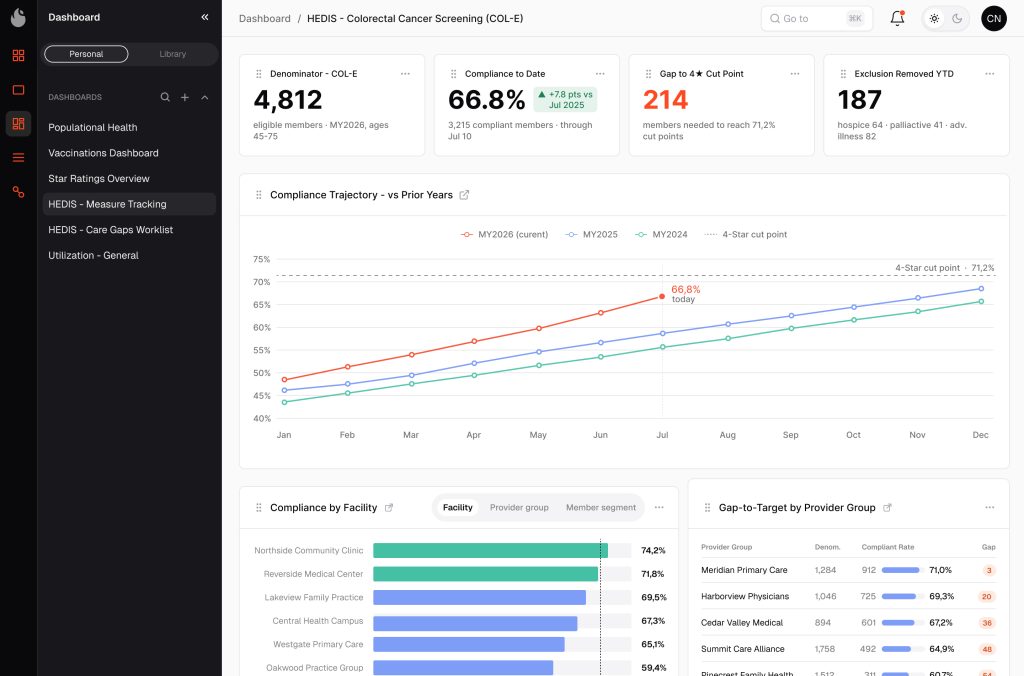
A rate tells you the size of the problem; a member list tells you what to do about it. Gap cohorts — the denominator, minus members with a qualifying numerator event, minus exclusions — are refreshed as data arrives and prioritized by time remaining in the measure window, by simultaneous open gaps, and by historical responsiveness. Through the platform’s APIs, these lists flow into the care management and outreach tools where intervention happens, so a gap detected today is worked today. A member who completes a screening on Monday disappears from Tuesday’s list.
This is where the care gap versus data gap distinction becomes practical. If a member appears overdue for preventive screening, the team can check whether evidence is missing or the care has not happened. If it is a data gap, the next step may be provider evidence capture. If it is a care gap, the next step may be outreach, scheduling, or care management intervention.
Temporal Queries: The Native Language of HEDIS Logic
Strip away the clinical content, and HEDIS measures are temporal logic: continuous enrollment with limited gaps, screenings within lookback windows, follow-up visits within 7 and 30 days of discharge, age as of a specification date. Kodjin Analytics treats these relationships as first-class analytical constructs available on demand — event-anchored windows, lookback logic, sequence conditions, and duration measures — re-evaluated automatically as new data streams in.
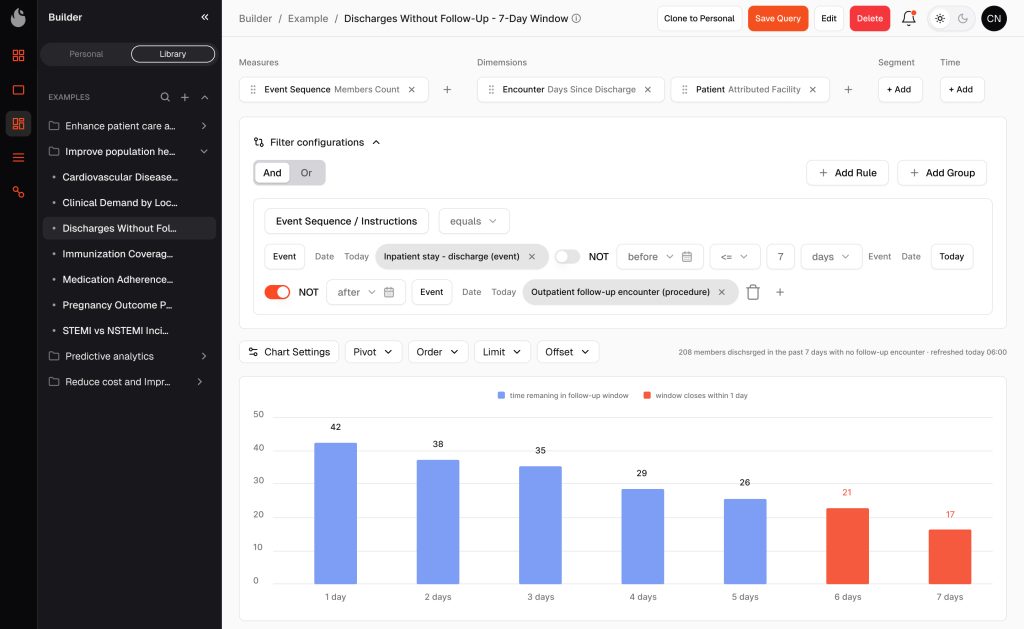
Computed retrospectively, a follow-up-after-discharge rate is an autopsy. Run as a daily temporal query, it becomes an early-warning system: each morning, the platform surfaces members discharged in the past seven days with no follow-up encounter, ranked by days remaining, so coordinators can intervene inside the window — the only time it counts. Medication adherence measures work the same way, exposing at any moment who is inside a treatment phase and who is trending toward failure early enough for a refill outreach to change the outcome.
AI-Powered Conversational Analytics
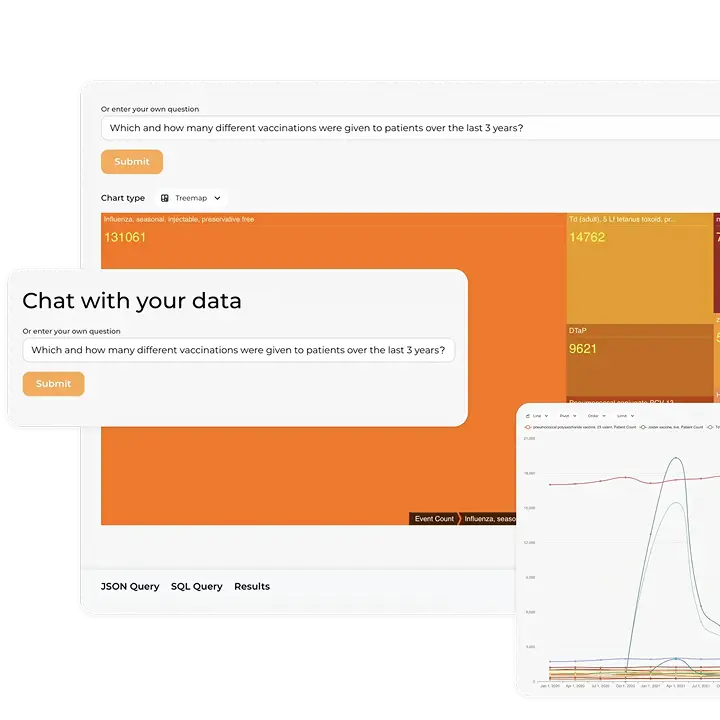
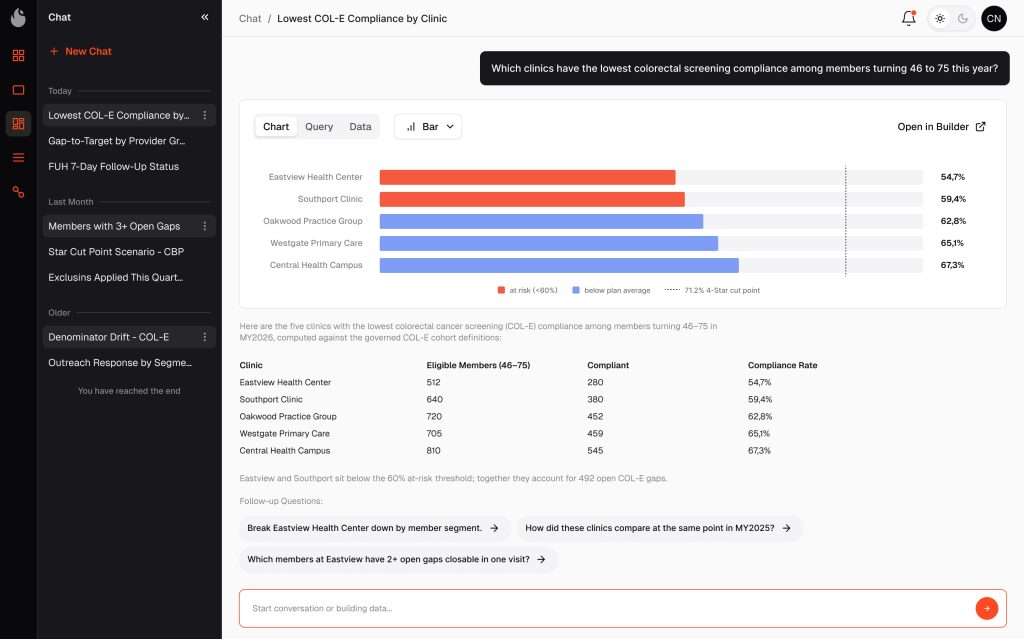
Cohorts, metrics, temporal logic, and pathway models all live in a governed semantic layer — and that layer is conversational. An LLM-powered analytics assistant lets any authorized user ask questions in plain language, such as “Which clinics have the lowest colorectal screening compliance among members turning 46 to 75 this year?”, and get grounded answers computed through the same governed definitions as every dashboard and API — then follow up, drill down, and compare without writing a query or filing a ticket.
Governance holds throughout: role-based access applies to conversational queries exactly as it does to dashboards, and protected health information is never exposed to the model — data access, query execution, and result delivery remain inside the platform.
Pathway Analysis: Seeing How Gaps Form
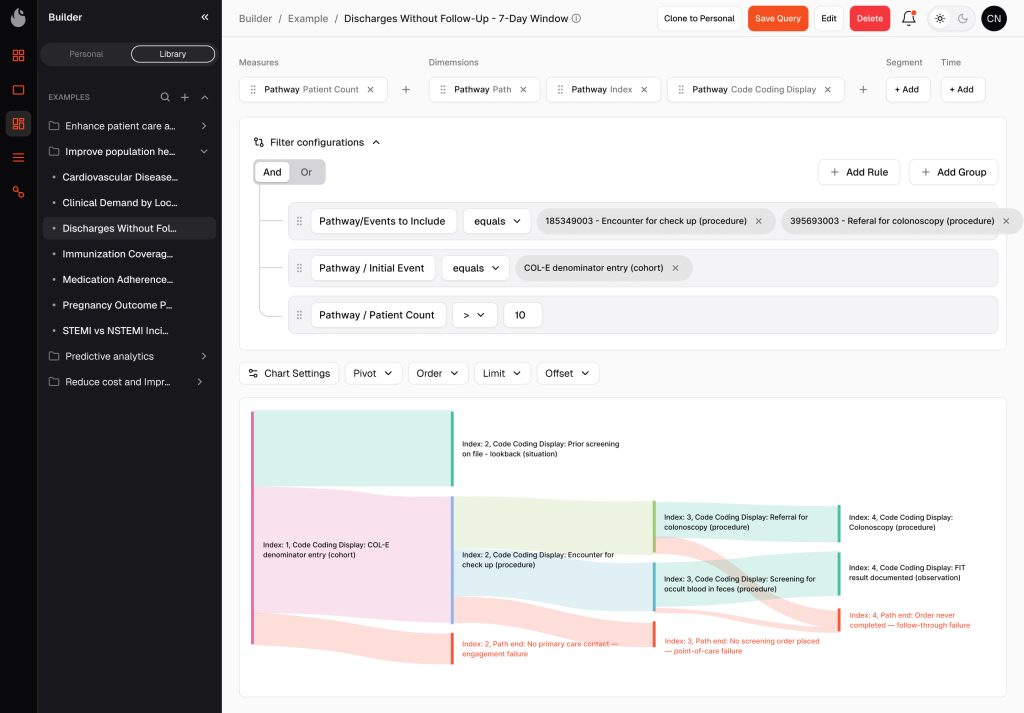
Pathway Analysis adds patient-journey visibility for measure areas where timing and sequence matter. Gap lists answer who; Pathway Analysis answers why. It reconstructs the ordered sequence of clinical and operational events for every member and aligns those sequences across the population, so teams can see where follow-up breaks down, where transitions take too long, or which event sequences are associated with avoidable gaps.
In colorectal cancer screening, for example, pathway analysis can separate three very different non-compliant segments — members whose screening order was never completed, members seen in primary care with no order placed, and members with no primary care contact at all — each demanding a different intervention.
Comparing the journeys of members whose gaps closed after outreach against those whose did not also shows which intervention sequences actually precede compliance.This is especially useful for transitions of care, chronic condition management, behavioral health follow-up, and pathway variation across provider groups.
Where Quality Performance Becomes Business Impact
Quality performance affects each organization differently, but the operational problem is shared. Payers need reliable evidence for reporting, ratings, contracts, and member programs. Provider networks need timely visibility into gaps they can still close. Vendors need a data foundation that lets them support quality workflows without rebuilding interoperability from scratch.
Payers, Health Insurers, and Managed Care Organizations: For payer organizations, HEDIS performance becomes a business issue before the annual reporting step. A low rate may mean members did not receive the needed care. It may also mean the care happened, but the evidence never reached the plan. In both cases, the payer has less time to intervene, improve preventive care, and avoid costs tied to delayed or missed action.
The financial impact depends on the line of business. In Medicare Advantage, Star Ratings connect quality performance with bonus payments, rebate positioning, benefit design, plan competitiveness, and enrollment strategy. Marketplace quality ratings can also influence how members compare plan options. In Medicaid managed care and commercial value-based arrangements, HEDIS-related performance can shape state program discussions, provider incentives, contract accountability, and network management. The common problem is the same: payer teams need reliable data early enough to act, not just clean numbers at the end of the reporting cycle.
Provider Networks, ACOs, and MSOs: Provider organizations are often the teams that close gaps, document care, and support member or patient follow-up. They may also carry quality accountability through value-based contracts, delegated risk, ACO arrangements, MIPS, or payer-provider incentive programs. Many provider contracts include HEDIS-related quality incentives, and payers use HEDIS measures to reward high-performing providers.
For these teams, the practical need is timely, trusted evidence about care delivery, open care management gaps, and closure activity before the performance period ends. If a screening was completed but not visible, the provider may be asked for records again. If a follow-up never happened, the team needs enough time to reach the patient and close the gap. Better data helps separate those two situations earlier.
Healthcare Vendors and Digital Health Companies: Vendors that serve payers, health insurers, managed care organizations, or provider networks can use the same foundation to add quality analytics, cohort monitoring, gap views, and reporting workflow support to their products. Instead of treating HEDIS-related functionality as a separate reporting module, they can build on standardized data, terminology alignment, and reusable quality logic that supports multiple measure areas and customer workflows.
Quality Performance Starts Before Reporting
HEDIS scores are annual, but the care that produces them happens every day. HEDIS reporting will still end with formal calculation, validation, and submission. But performance improvement starts earlier: teams need to know which gaps are real, which gaps are caused by missing evidence, and where intervention can still change the outcome.
Kodjin helps organizations and their partners build that working layer by connecting fragmented data, normalizing it into FHIR, aligning terminology, validating data quality, and turning measure-relevant evidence into operational analytics. Quality teams can monitor configured indicators, identify gaps earlier, prevent avoidable gaps where the data allows, track closure activity, and prepare cleaner evidence for downstream reporting workflows.
When the certified engine computes the official rate, it operates on clean, complete, FHIR-structured data — and produces a number the organization has been watching converge all year: the outcome of deliberate intervention, not a surprise.
HEDIS® is a registered trademark of the National Committee for Quality Assurance (NCQA). Kodjin Analytics is not NCQA-certified measure software; official HEDIS reporting requires certified measure logic and the HEDIS Compliance Audit™.