Industry: Healthcare
Country: US
Project type: Analytics Platform
Duration: Ongoing
Kodjin Analytics brings patient identification and eligibility analysis to clinical trial recruitment. Find several times more eligible patients in the data your sites already hold, and screen whole populations in minutes. Automate the data work behind recruitment and turn more of your existing patient population into revenue. This clinical trial recruitment solution is part of a broader Kodjin Analytics.
Designed for:
Head of Clinical Trial Recruitment Principal Investigators Chief Research Officers Director of Clinical Trials Trial SponsorsPatient recruitment is where most trials lose time. A Phesi analysis of more than 600,000 trial protocols found that fewer than a third are linked to real patient data, a disconnect that fuels recruitment delays and costly amendments before the science is ever in question.
Manual chart review and analyst-coded queries during clinical trial recruitment widen the gap. Recruitment coordinators spend time collecting and reviewing records instead of recruiting, eligible patients remain undiscovered, and research leaders lack a clear view of the potential patient pool.
Kodjin Analytics turns your patient data into a recruitment-ready eligible pool. It helps you screen entire populations in minutes, compare expected pools across sites, and give recruitment teams a data-backed starting point instead of a manual chart-collection task.
With Kodjin Analytics, research & clinical trials teams can:
Kodjin Analytics tells you which patients qualify for a study, and why. Most clinical trial recruitment services coordinate outreach once candidates are flagged. Kodjin works one step earlier, screening the full population and continuously reviewing eligibility logic.
Each role in a study experiences the bottleneck differently, yet all work from a single data foundation. The patient recruitment services delivered through the Kodjin Analytics platform fit how each one already operates.

Start each study with a prioritized candidate list. Kodjin Analytics shows who meets the criteria and who to contact first, so screening targets the right patients rather than blindly working through the whole panel.

See a realistic, data-backed feasibility estimate before committing to a protocol. Kodjin Analytics counts the number of eligible patients for a given profile, so a site knows whether it can deliver enrollment.

Spend less time assembling data and more time enabling research. Kodjin Analytics’ semantic layer removes manual joins across EHR, registry, and claims data so that domain experts can run cohort queries themselves and your team can focus on insights.

Standardize screening across multiple sites using a single query layer. Acting as a patient recruitment company for clinical trials, a CRO applies the same eligibility logic across sites and reports progress from a single source of truth.

Turn research capacity into a strategic asset. With one view of how many eligible patients each study can reach, a Chief Research Officer prioritizes the trials the organization can actually deliver and reports portfolio feasibility with confidence.

Run a single consistent screening method across all sites. A FHIR-native clinical trials patient recruitment approach replaces a different process at each location with shared, comparable logic and reporting.
Insufficient enrollment is the leading cause of trial halts, so the speed and accuracy of screening determine whether a study enrolls on time.
Searching the entire population, rather than reviewing charts one at a time, identifies eligible patients that manual methods miss. In the Zoadigm FHIR semantic layer analytics platform built on Kodjin technology, end clients achieved a 9× higher match rate in candidate selection than with standard screening.
A wider, more accurate candidate pool and a measurable lift in enrollment.

A Phesi analysis of nearly 12,000 investigator sites found that almost one in five enroll just a single patient, contributing under 3% of participants, so weak screening at the site level is a leading drag on timelines.
Kodjin Analytics screens a site's entire population within minutes, so coordinators see the actual eligible pool before a study starts. Stronger early enrollment keeps a clinical trial patient recruitment plan on schedule, rather than forcing sponsors to add rescue sites later.
Fewer under-enrolling sites and a faster path to first patient in.

Average trials lose 25% to 30% of participants to dropout, and each one weakens the study’s statistical power and inflates its cost, so retention is a direct economic lever.
Kodjin Analytics is not a trial management or monitoring system. It analyzes the clinical data you already govern, and once enrollment status is part of that data, teams can follow a participant's longitudinal journey and outcomes over time, then pass what they see to the coordinators who act on it. That visibility is what keeps any clinical trial recruitment company viable over the full length of a study.
A clear view of patient journeys and outcomes after enrollment, from data you already hold.

Sites are paid per enrolled participant and per visit completed. A 2026 study in the Journal of Clinical and Translational Science found visit-based payments to be a community research site’s core income stream.
Kodjin Analytics grows that revenue at the source. Screening the full patient population in minutes surfaces eligible candidates a chart-by-chart review would never reach, so a site enrolls more patients per study and earns more of the budget it signed. Every eligible patient who is never identified is revenue the site never bills, which is why teams comparing patient recruitment solutions judge them on how many candidates each one surfaces.
More enrolled patients per study, and more of the site budget actually earned.

Higher Match Rates than Manual Screening

Faster, Fuller Site Enrollment
Clearer Patient Journeys after Enrollment
Measurable Revenue from Better Enrollment
Take a live walkthrough of the clinical trial recruitment software on a synthetic dataset, tailored to your therapeutic area. Tell us your eligibility criteria, and we will shape the demo around them.
Bring your questions to a no-pressure call and leave with expert guidance and a clear starting point.

Traditional tools screen a single registry in isolation. Still, the questions that matter most, such as which patients meet a complex sequential profile, require clinical data integrated with claims, medical history, and timing. Kodjin's semantic layer does exactly that, giving sponsors in multi-site or global studies a single consistent eligibility method rather than separate recruitment solutions at each site.
What Kodjin does
What it means for your organization
Unifies EHR, registry, and claims data
One complete view of each candidate across every system
Lets domain experts define cohorts in plain language
Coordinators set the criteria themselves, with no engineering help
Applies complex temporal logic natively
Sequential and time-window criteria run with no custom code
Enforces HIPAA controls and audit trails
Every query runs within HIPAA controls, so PHI access is controlled and logged
Supports FHIR-native interoperability
Trial data flows cleanly across sites, registries, and sponsors
Clinical trial recruitment is one of the most powerful ways to use Kodjin, and the same platform supports clinical, operational, and research analytics on a single data foundation.
Explore related use cases:
Effective clinical trial recruitment services require clean data flowing between EHR, registry, and operational systems. Kodjin supports the full data lifecycle, from ingestion to AI-powered exploration.
Recruitment analytics depend on consistent, validated data. Kodjin consolidates EHR, registry, and administrative data into a unified foundation, so cohort and eligibility insights are trustworthy and complete.
Build AI-powered trial recruitment apps, eligibility alerts, and screening dashboards on Kodjin's semantic layer with pre-built healthcare components and any LLM provider.
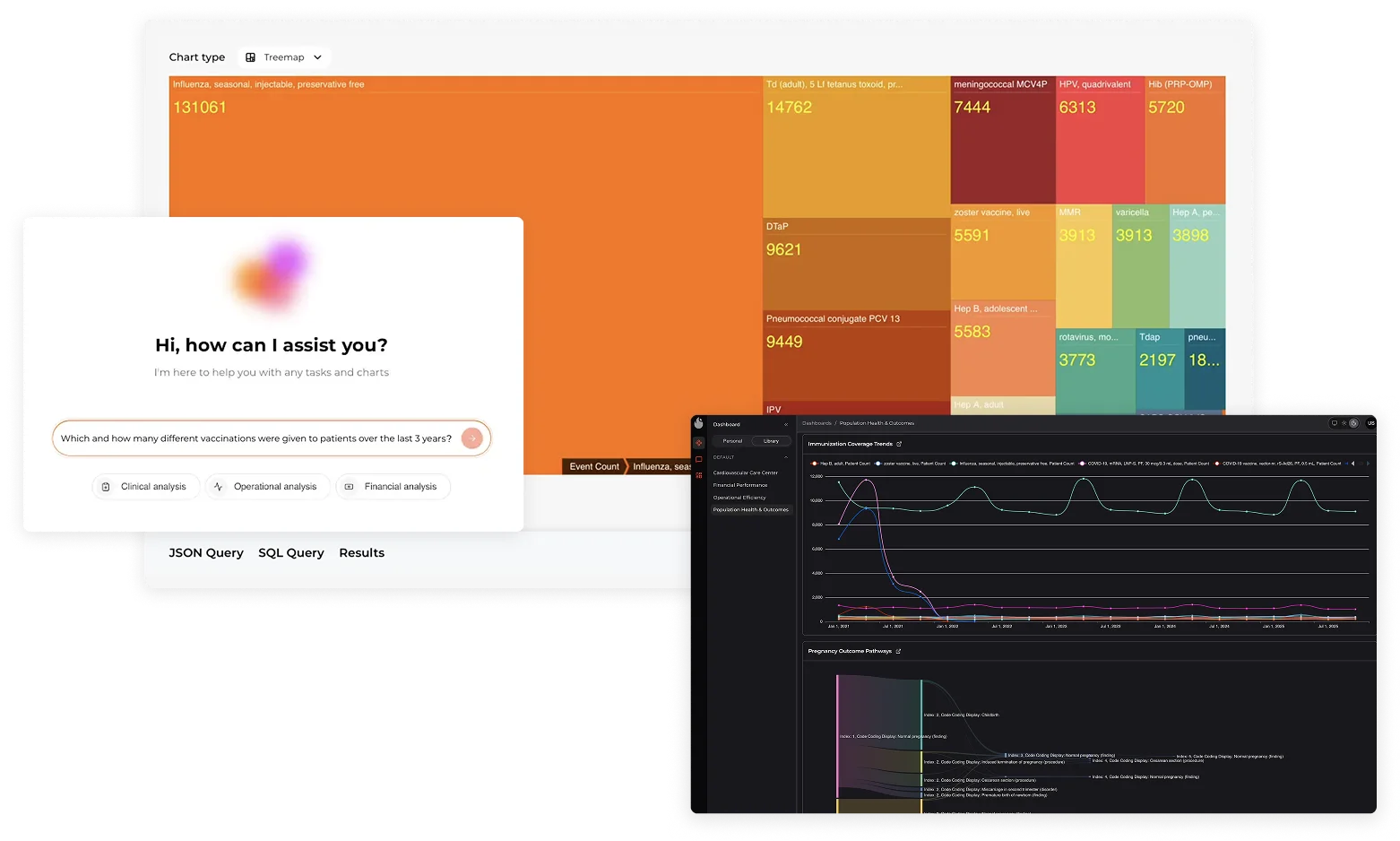
Kodjin reads your FHIR-structured records and runs eligibility criteria across the entire population at once. A coordinator describes the cohort in plain language, and the clinical trial recruitment software returns matching patients in minutes, replacing manual chart review with a repeatable query that reruns as data updates.
FHIR preserves the relationships between conditions, medications, encounters, and observations rather than flattening them. Kodjin’s semantic layer turns those nested resources into business concepts, then matches them against trial criteria, including complex time-based rules, without requiring anyone to write code.
Yes. Kodjin connects through FHIR and custom connectors, so it works alongside your current EHRs and data systems. You gain a single query surface across sources, which is why many patient recruitment vendors standardize on this approach instead of replacing core systems.
The platform enforces role-based access, de-identification where appropriate, query logging, and full audit trails. Every transformation follows HIPAA requirements, so a patient recruitment agency can recruit safely while protecting health information.
By searching all records at once, Kodjin reduces candidate identification time from weeks to minutes and surfaces a larger pool of eligible candidates. Faster, broader screening is how a clinical trial recruitment solution shortens startup and helps sites hit enrollment targets.
A traditional patient recruitment company for clinical trials often layers manual outreach on top of slow data work. Kodjin attacks the data layer directly, giving any clinical patient recruitment team the screening speed, accuracy, and auditability that manual services cannot match, while keeping the work in-house.
Please leave your email to get Kodjin Analytics Solution Brief
We have sent a copy to your email

Please leave your email to get Kodjin Data Platform Solution Brief
We have sent a copy to your email
Back to website content