Industry: Healthcare
Country: US
Project type: Analytics Platform
Duration: Ongoing
Going to EHRCON26? Meet us in Amsterdam, Sept 22-23
Book a MeetingKodjin is an AI-powered data platform that helps healthcare organizations move from reactive reporting to proactive population health management. Population health management software is a part of broader Kodjin Analytics.
Designed for:
CMOs VPs of Population Health CFOs Department Directors Care CoordinatorsMost population health management (PHM) systems follow a similar model: aggregate data, stratify risk, display results on dashboards, and optimize care management workflows. They are strong systems of execution, but their analytics are inherently constrained:
Teams act on what the system already knows, but struggle to test new hypotheses. The intelligence is locked inside predefined logic.
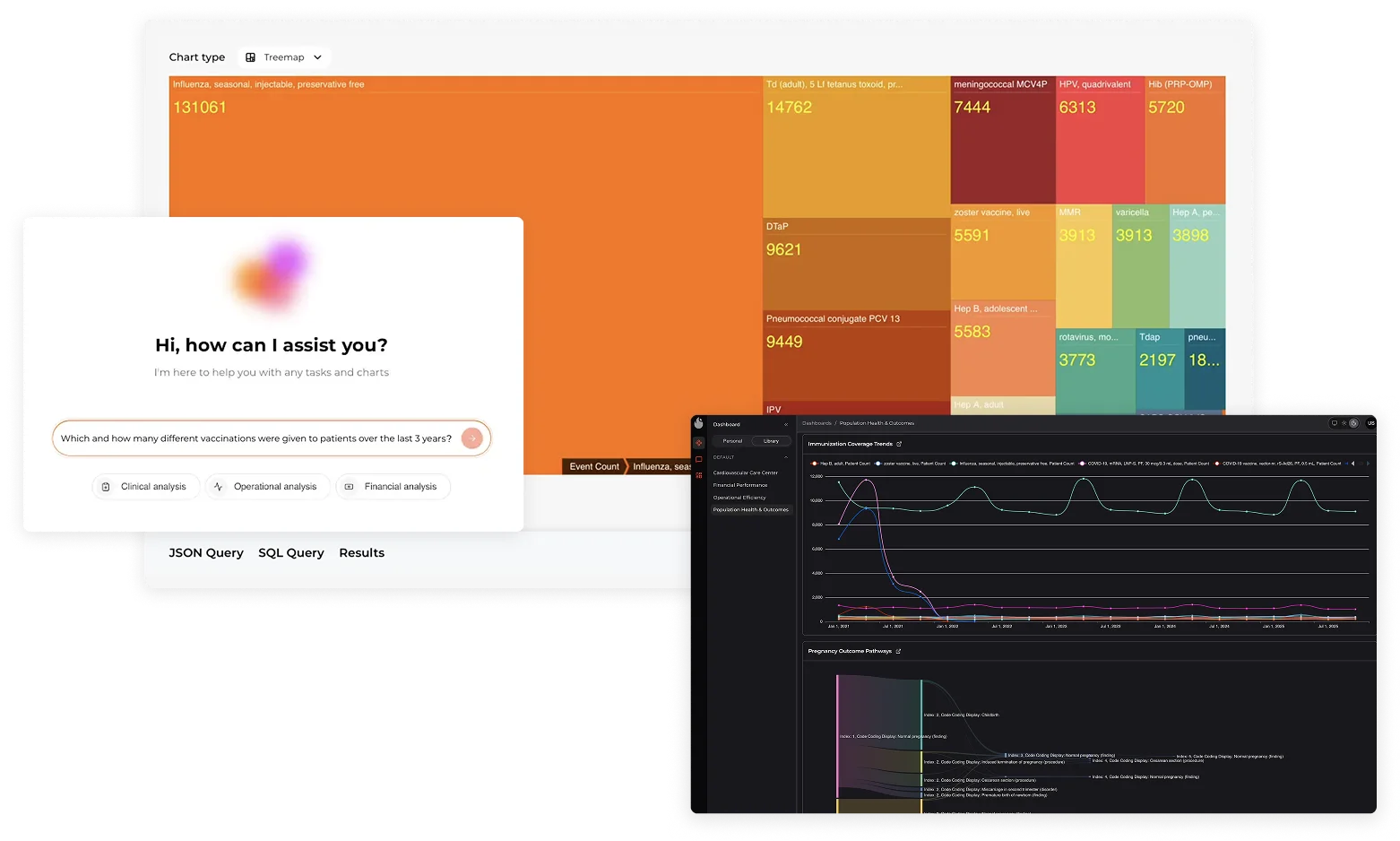
Kodjin Analytics helps organizations shift from static reporting to dynamic, AI-assisted exploration. Unlike solutions built on periodic data extracts, Kodjin works with real-time data, so teams get answers based on what’s happening now. It brings fragmented data into a single knowledge layer and lets teams interact with it through natural-language or visual query building, without SQL or an analyst bottleneck.
With Kodjin Analytics, organizations can:
Most PHM platforms tell you which patients are at risk. Kodjin Analytics lets you discover why and find the ones they miss, using pathway and temporal logic. Instead of locking insights behind predefined risk tiers and static cohorts, Kodjin gives teams the freedom to explore population data directly and uncover new patterns.
Identify rising-risk patients earlier, close care gaps across sites, and strengthen performance in value-based contracts. Kodjin gives clinical and operational teams a single population view across facilities, so risk stratification, quality tracking, and care coordination work consistently, whether you run three clinics or thirty hospitals.
Segment member populations precisely, forecast costs under risk-based models, and track quality measures like HEDIS and Star Ratings in real time. Kodjin helps actuarial, quality, and care management teams connect claims, clinical, and social data to identify where interventions will have the greatest impact on outcomes and total cost of care.
Monitor population-level trends across regions, detect emerging health threats, and allocate resources based on actual community needs. Kodjin turns fragmented surveillance and registry data into a shared intelligence layer, so epidemiologists, program directors, and policy teams can act on current data instead of waiting for quarterly reports.
According to the Peterson-KFF Health System Tracker, the top 10% of patients by health care costs account for 63% of total healthcare spending. The top 1% alone accounts for 20%.
Kodjin helps organizations identify and understand these high-cost populations and what’s driving their costs. Teams can analyze cost patterns by episode, provider, condition, and service line, and explore how social and clinical factors intersect to create spending concentration.
More precise targeting of interventions, evidence-based resource planning, and stronger performance in risk-based contracts.

NCQA reports that more than 235 million people are enrolled in plans that report HEDIS results, making it one of healthcare’s most widely used performance improvement frameworks. Yet quality gaps in screening, chronic disease control, and follow-up persist across populations.
Kodjin enables quality teams to identify who needs screening, where diagnosis gaps remain, and which providers are falling behind benchmarks, and to act before reporting periods close.
Higher quality scores, maximized incentive payments, and a shift from reactive reporting to continuous quality management.

U.S. healthcare spending is projected to reach $8.6 trillion by 2033, according to CMS. As spending accelerates and value-based models expand, the ability to segment populations precisely becomes a competitive necessity.
Kodjin lets teams build and refine population cohorts in minutes, combining clinical conditions, utilization history, social determinants, and financial data in a single query. Teams can discover rising-risk subpopulations, test new stratification hypotheses, and validate assumptions without writing SQL.
More adaptive risk stratification, faster response to emerging population trends, and the ability to act on insight before it becomes outdated.

A recent AHA analysis found that the hospital case-mix index, a measure of patient acuity, rose approximately 5% between 2019 and 2024, and hospital expenses grew 7.5% in 2025, more than twice the rate of price growth, as hospitals continue treating more clinically complex patients.
Kodjin connects population health performance directly to financial outcomes, helping leaders forecast costs, track shared savings, and negotiate payer contracts with data-driven confidence.
Stronger positioning in ACO and capitation models, better cost forecasting, and tighter alignment between clinical and financial strategy.

Targeted Cost Management Across High-Risk Populations

Proactive Quality Gap Closure Across Populations
Faster Population Segmentation and Risk Discovery
Stronger Performance in Value-based Contracts
Take a look at the population health solution in a guided, live walkthrough tailored to your organization’s priorities.
Kodjin helps clinicians, managers, and care coordinators explore population health data independently, without relying on analysts or technical specialists.


Gain a strategic view of where population risk is building, which cohorts are underperforming, and where clinical variation is driving unnecessary cost. Kodjin helps CMOs connect population trends with clinical priorities and drive earlier, evidence-based decisions without relying on analysts.

Move beyond predefined risk tiers and static cohort definitions. Build and refine population segments instantly by combining clinical conditions, utilization patterns, social context, and financial outcomes to identify care gaps that standard models miss, enabling more precise and adaptive strategies.

Understand the true cost drivers behind high-risk populations and value-based contracts. Kodjin helps CFOs connect population health performance to financial outcomes, identify underutilized resources, and protect revenue under risk-based payment models.

See how treatment pathways actually perform across populations. Identify variation, missed follow-ups, and transition risks that aren’t visible in standard reports. Kodjin helps department leaders find where efficient protocols break down and where standardization can improve outcomes.

Track quality measures like HEDIS, CMS Star Ratings, and MIPS in real time instead of waiting for quarterly reports. Kodjin helps quality teams close gaps before reporting periods end, accelerate audit response, and maximize incentive payments

Get a complete picture of each patient’s risk, history, and care gaps without navigating multiple systems. Kodjin helps care teams quickly surface what matters most, answering questions directly against the data and providing prioritized patient lists to improve outcomes at the point of care.
PHM depends on connecting data that was never designed to work together: claims from payers, clinical records from multiple EHRs, lab results, SDOH screenings, and utilization data across care settings. Kodjin’s semantic layer unifies these sources into a shared knowledge model where data is organized around clinical and business meaning.
What Kodjin does
What it means for your organization
Unifies data from EHRs, claims, registries, and patient apps
One consistent population view instead of fragmented snapshots from disconnected systems
Structures data around clinical and business meaning
Risk factors, conditions, medications, and costs are connected logically
Preserves relationships between population health concepts
Teams can see how comorbidities, utilization patterns, and social factors interact within a cohort
Makes population data explorable without technical skills
Clinicians and managers ask questions in plain language; the semantic layer handles the complexity underneath
Keeps metrics consistent across tools and teams
Whether accessed through AI, dashboards, APIs, or embedded apps, the same cohort definition means the same thing everywhere
Enables real-time data ingestion and near-instant queries
Population insights reflect current data, not last quarter’s extract
Most population health management platforms follow a standard architecture: aggregate data, stratify risk, present results on dashboards, and optimize workflows. Kodjin goes further, giving your teams direct, flexible access to population health data instead of another layer of fixed analytics.
Traditional PHM Platforms
Kodjin Analytics
Getting answers
Require dashboards, analysts, and data teams to configure and validate new analyses
Ask questions directly in plain language. No need to build dashboards or write queries first
Speed of analysis
New analysis = setup + validation. Takes hours or days
Ask → explore → refine in real time. Takes minutes
Who can use it
Mainly analysts and data teams. Others rely on reports
Clinicians, managers, product teams — anyone can explore data directly
Data understanding
Data is available, but often technical. Interpretation depends on experts
Data is structured in business and clinical terms that teams already understand
Interoperability
Depends on integrations and data pipelines. Data can be fragmented
FHIR-native core with bi-directional data exchange. Unified data + unified meaning
Data freshness
Built on periodic data extracts and static snapshots. Insights reflect conditions from the last reporting period
Analytics run on fresh, real-time data. Teams see current population trends as events unfold
Population health management touches every part of a healthcare organization, from clinical operations to finance to research. Kodjin supports all of them on a single analytics foundation, so you don’t need separate tools for each initiative.
Explore related use cases:
Strong population health management requires more than analytics alone. It depends on reliable data exchange across partners, consistent terminology, and the ability to operationalize insights through applications and automation. Kodjin supports all of this on the same platform.
Population health programs depend on data flowing cleanly between EHRs, payers, registries, and care partners. Kodjin consolidates, normalizes, and validates this data, creating the interoperable foundation that PHM analytics and coordination tools require.
Turn population health insights into operational tools. Kodjin’s semantic layer enables development teams to build AI-powered applications, risk alerts, care gap notifications, and cohort-specific workflows on top of a shared data foundation, using any LLM provider without additional training.
It depends on what matters most to your organization, but a strong population health management platform should help you move the needle across three areas.
Clinically — look at readmission rates, care gap closure, chronic disease control (think HbA1c, blood pressure targets), and screening completion.
Financially — total cost of care per member and how you’re tracking against value-based contract benchmarks.
And operationally — how fast can your teams get answers? How many people actually use the population health management tool day to day, without needing analyst support?
Kodjin lets you monitor all of this in real time, so you’re not learning about problems after the reporting window has closed.
Building population health management software from scratch sounds appealing until you factor in the true cost: semantic modeling, data pipeline maintenance, and keeping up with regulatory changes year after year.
On the other hand, many off-the-shelf population health management solutions come with rigid workflows and vendor lock-in, making it hard to adapt as your needs evolve.
Kodjin sits somewhere in between. It’s modular and infrastructure-agnostic, so you assemble only what you need and skip the rest. That makes it a practical population health management solution if you want to get up and running quickly without painting yourself into a corner.
Kodjin is a scalable population health management software that handles millions of patient records with sub-second query performance. Infrastructure is managed via IaC, ensuring deployments remain consistent whether you’re running in the cloud or on-premises. The platform processes data in near real time and in batches, so it grows with your population. Organizations running population health management systems at a national scale use this same architecture.
Yes, Kodjin handles real-time ingestion, scheduled batch loads, and on-demand pulls. Data quality checks run automatically, so what reaches the analytics layer is clean and reliable. Your care management teams and clinical staff work with current data, not last month’s snapshot. The population health management dashboard reflects what’s actually happening now, which makes a real difference when you’re trying to improve outcomes through timely intervention.
You don’t need a team of FHIR specialists or data engineers to get started. We handle the heavy lifting, adapting the platform to your data model and clinical workflows, setting up pipelines, and training your people. After launch, the population health analytics software is built for non-technical users. Clinicians, managers, and coordinators can explore data independently using AI-assisted queries and visual population health management tools. The goal is real self-service across your healthcare ecosystem.
Security and compliance are baked in, not bolted on. The population health management software is HIPAA- and GDPR-compliant, ONC-certified, and Gematik-certified. Access is managed through role-based controls and SMART on FHIR, with full audit trails on every query. Organizations using population health management tools across multiple jurisdictions can rely on efficient data governance protocols that don’t impede day-to-day analytics work.
We build for handover, not dependency. After deployment, your team maintains and extends the system with low-code tools for ELT, deployment, and operations. The platform is infrastructure-agnostic, cloud or on-premise, your call, with minimal lock-in. We also provide training, documentation, and knowledge transfer so you’re self-sufficient from day one. As your intelligence needs grow, Kodjin grows with you. And when you need something custom, we can build on top of the platform to help drive better financial outcomes without sacrificing your operational independence.
Please leave your email to get Kodjin Analytics Solution Brief
We have sent a copy to your email
Please leave your email to get Kodjin Data Platform Solution Brief
We have sent a copy to your email
Back to website content