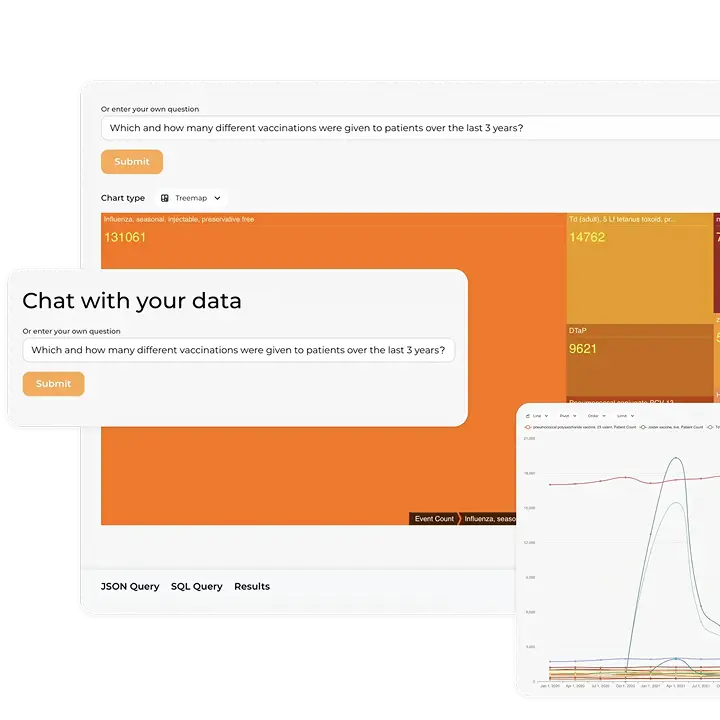
To reduce variation in care, a health system traces the routes patients actually take through treatment, holds those routes against evidence-based protocols, and standardizes toward the ones that produce better outcomes. Done well, this turns care variability from a cost the organization absorbs without noticing into something it can see and manage.
A landmark JAMA analysis estimated that roughly 25% of U.S. healthcare spending is waste, between 760 and 935 billion dollars a year, with unwarranted clinical variation and low-value care among its core drivers. Narrow that gap, and you improve outcomes and protect reimbursement at the same time.
The obstacle has rarely been a lack of guidelines. There has been a lack of visibility into what actually happens between admission and discharge, made worse by the slow, one-off nature of the analysis that tries to surface it.
Kodjin by Edenlab was built to remove both. As a FHIR-native platform for healthcare analytics software, it standardizes clinical and claims data into a single model, then layers pathway analytics and natural-language querying on top, so measuring variation becomes a daily habit run by clinical leaders themselves. The sections below show how, and where it shifts the economics for providers and payers.
Highlights:
- Unwarranted variation in healthcare is a hidden daily cost, seen in longer stays, repeat tests, and unpredictable outcomes, with waste estimated at up to 25% of US spending.
- The EHR records events but not pathways, so leaders cannot see where care diverges from protocol without reconstructing the patient journey first.
- Traditional clinical variation reduction runs as a slow, one-off retrospective project whose findings are stale by the time they arrive.
- Kodjin turns variation analysis into a daily practice via a shared FHIR model, pathway and temporal analytics, and self-service conversational querying.
- The loop from spotting variation to standardizing and confirming the effect shrinks from quarters to days, run by clinical leaders, with data kept inside HIPAA- and GDPR-aligned infrastructure.
What Is Variation in Care Really Costing You?
Two patients arrive on the same ward with the same diagnosis, their risk scores within a point of each other. One goes home on day three and never returns. The other stays six days, collects an extra imaging study, and is readmitted within the month, though nothing in either chart explains the gap. That gap is unwarranted variation in healthcare, and an organization pays for it quietly, day after day, without ever seeing a bill that says so.
The expense hides because it never lands under one heading. It surfaces as avoidable bed-days, as repeat labs ordered when a previous result was not trusted or not found, and as outcomes leadership cannot forecast from quarter to quarter.
W. Edwards Deming called uncontrolled variation the enemy of quality, and the wards prove him right every week: when treatment for one condition drifts from clinician to clinician, the drift becomes a cost center no budget line ever named.
Numerous studies estimate that as much as 30% of healthcare spending may be waste. Much of it is the residue of small, undocumented choices that pulled care off the most effective path for no reason a chart can defend.
For the people who own clinical results, this stopped being academic some time ago. A Chief Medical Officer answers for outcomes, and a Chief Quality Officer answers for the measures those outcomes roll up into, measures that now sit inside the payment itself.
HEDIS scoring rewards consistent, evidence-aligned care, CMS Star Ratings move on the same axis, and MIPS attaches dollars to how tightly performance tracks the standard. Variance in healthcare, once filed under quality and reviewed in a committee, has become a direct input to what the organization gets paid.
Why Does Standardization Stall Before It Starts?
It is tempting to assume the problem is awareness, that leaders simply do not know variation is there. The opposite is closer to the truth. Most quality leaders can name the service lines where care wanders and the outcomes that suffer for it. The wall they hit is not knowing that variation exists; it is seeing it in enough detail to act.
Seeing means reconstructing the real route each patient took, in enough detail and across enough patients that a pattern becomes something you can act on. This is where the electronic health record leaves a leader stranded.
The EHR records events well: a lab ordered at one hour, a medication given on the next shift, a consult requested two days later. Yet without EHR interoperability, it never lifts its head to show the whole journey across a thousand similar patients.
So it cannot tell you which treatment sequences recur, where one clinician diverges from another, or whether that divergence tracks with recovery or a return visit.
The events are all present while the pathway stays invisible, and standardization has nothing to aim at until someone rebuilds that pathway from the raw record.
The events are all present while the pathway stays invisible, and standardization has nothing to aim at until someone rebuilds that pathway from the raw record.
There is a harder obstacle underneath the technical one. Clinical variation reduction has traditionally arrived as a project, scoped and funded as a one-off, where a team of analysts spends months pulling data and cleaning records into a state anyone will trust.
By the time the report is presented, the clinical reality it describes has moved: staff has rotated, a protocol has been revised, and a new drug has changed the sequence the study was built on. The finding is accurate and stale at once, a photograph of a hospital that no longer exists.
That is why so many variation programs produce a binder rather than a change, and why the organization keeps paying for both the analysis and the variation it was meant to fix.
How Do You Reduce Variability in Care as a Daily Practice?
Guidelines alone will not close the gap. What changes the picture is a shorter loop between noticing variation and acting on it, measured in days, and run by the clinical leaders who own the outcomes rather than by a reporting queue. Kodjin builds that loop from three capabilities, each one useful only once the previous is in place.
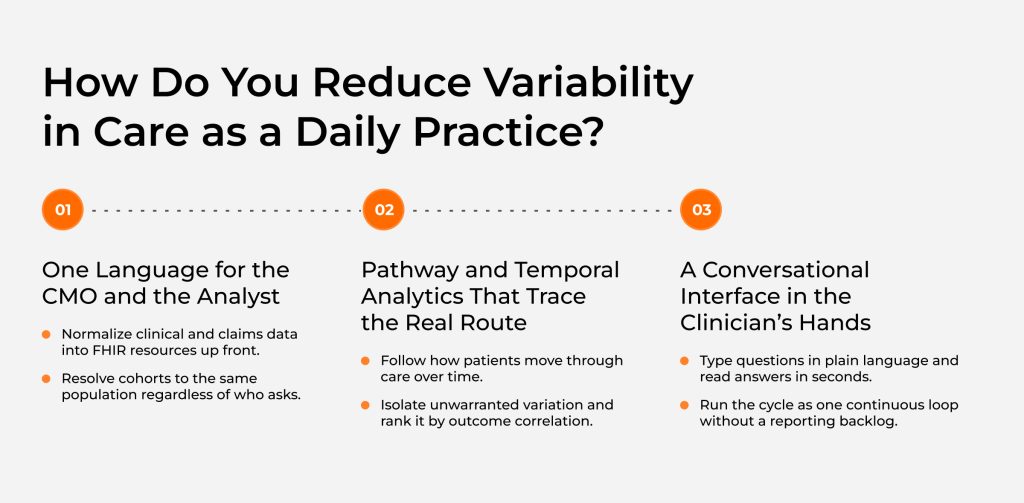
One Language for the CMO and the Analyst
Every variation project of the old kind spends its first stretch arguing about definitions, from what counts as a hip replacement patient to which encounters belong inside a sepsis episode. When a physician and a data engineer hold different answers, and a quality director a third, the analysis cannot begin, and reconciling those answers eats a large share of the budget.
Kodjin removes the argument by normalizing clinical and claims data into FHIR resources up front, using the Kodjin FHIR server as the common model. Hence, a cohort resolves to the same population no matter who asks. The shared standard becomes a shared vocabulary, and the weeks once lost to definition-wrangling are gone.
Pathway and Temporal Analytics That Trace the Real Route
With the data speaking one language, Kodjin’s pathway and temporal analytics do the work the EHR could not, following how patients move through care over time and setting those observed routes against the protocol they were meant to follow.
The output is the journey itself, laid out and compared, with deviations surfaced as findings a clinician can read at a glance: where the real path leaves the protocol, how often, and whether that deviation correlates with a worse result or is a harmless local preference.
Warranted variation, driven by genuine differences between patients, stays where it belongs. Kodjin isolates the unwarranted kind, ranks it by how strongly it tracks with outcomes, and puts it in front of the person who can act.
Sepsis makes the point concretely. Diagnosis is famously subjective and varies even among experienced clinicians, which is exactly the kind of unwarranted variation a pathway view exposes.
When one 800-bed medical center standardized its ED sepsis workflow into clear, band-based pathways across 2023 and 2024, sepsis-associated mortality fell from 10.7% to 6.5% and length of stay dropped by about three-quarters of a day. That view is what turns a known root cause into a fixable one.
A Conversational Interface in the Clinician’s Hands
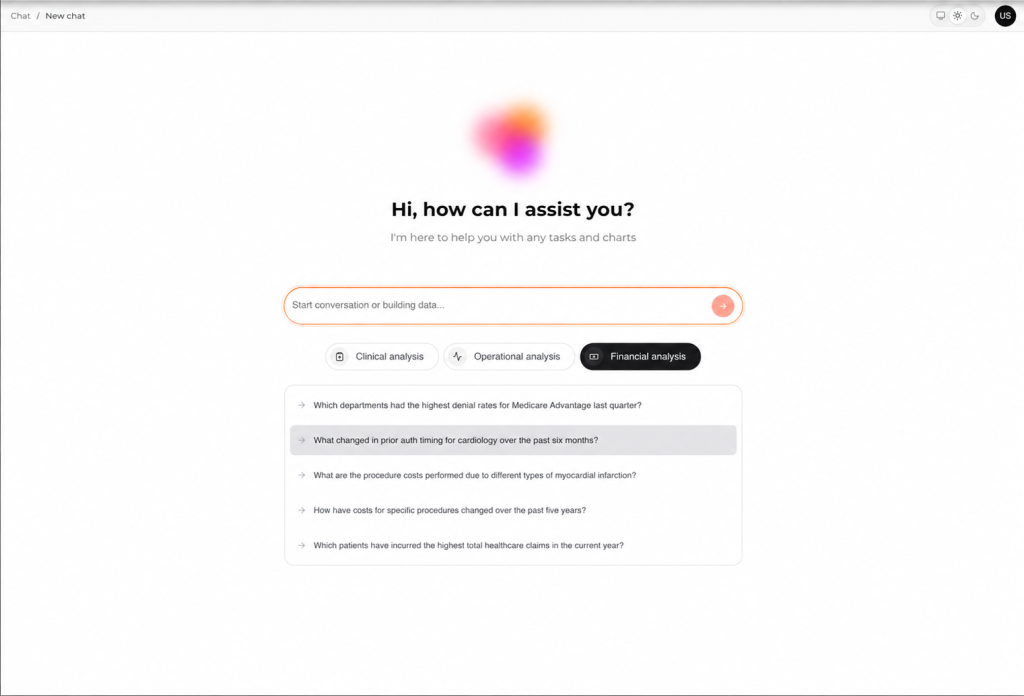
The third capability changes who gets to ask. Where a clinical leader once wrote a request and waited days for an analyst’s report, Kodjin’s conversational interface lets a CMO type the question in plain language and read the answer in seconds.
What are the most common treatment sequences for hip replacement patients? Which care pathways correlate with better outcomes for sepsis patients? The system answers from live data, with no ticket filed. A follow-up is the next sentence in the same conversation, not a new project, which is how clinical thinking works when a reporting backlog is not throttling it.
Together these capabilities move the ownership of variation work. The cycle runs as one continuous loop inside Kodjin: a leader sees the variation, finds the best practice hidden in the high performers’ pathways, standardizes toward it, then watches live data to confirm the change moved the outcome. The clinical leader who carries the result runs it, without a business intelligence team translating on their behalf.
What Changes When a Quarterly Project Becomes a Daily Loop?
The shift is most evident when the two models sit side by side. Speed is part of it, and so is who can reach an answer and how current it is, since a stale answer delivered quickly helps no more than a live answer only an analyst can pull. Kodjin gives clinical leaders both at once.
| Dimension | Traditional retrospective project | Continuous variation in care analytics |
|---|---|---|
| Cadence | One-off study, months to produce | Ongoing practice, answers in days or seconds |
| Who runs it | Central analytics team | Clinical leaders, self-service |
| Data freshness | Two quarters stale on arrival | Current, tied to live patient pathways |
| Unit of insight | Static cohort report | Observed pathway versus protocol, ranked by outcome |
| Definitions | Renegotiated each project | Set once in FHIR, reused everywhere |
| Result | A binder that ages before it acts | A closed loop from insight to standard |
A real program shows what this looks like. Lifepoint Health ran an unwarranted care variation reduction effort on high-quality data paired with strong physician leadership, starting in sepsis and heart failure, and reported more than six hundred lives saved through reduced mortality in those conditions.
Software alone did not produce the number. Physicians changed practice once they could see their own pathways measured against the evidence, quickly enough that the finding still described the patients in front of them. That mix of speed and clinical ownership is what Kodjin is built to make routine.
What Does Reducing Variation Ask of Your Data?
None of the three capabilities is worth much if the data underneath cannot be trusted, so it helps to name the healthcare data challenges that reducing variation has to solve first. Kodjin brings clinical and claims data into a shared FHIR standard, so a pathway can be reconstructed and compared to protocol without a translation layer distorting it.
It also depends on consistent identifiers and reliable timestamps kept current, since a temporal analysis is only as honest as the clock it runs on.
Governance has to stay out of the way of the work without loosening its grip on the records. Pooling sensitive data across departments and sites means keeping it inside managed infrastructure aligned with HIPAA and GDPR, not exported into loose spreadsheets on a dozen laptops. The same normalized layer that powers the analysis keeps access controlled and every query auditable.
Where Does the Payer Fit In?
Everything above speaks first to providers, to the CMO and Chief Quality Officer and department heads who answer for outcomes. A second audience has a direct stake inside the payer: leaders running value-based care programs live on the same link between quality and reimbursement, from the other end of it.
When contracts price outcomes, the analytics that expose variation feed the terms that reward or penalize it. An arrangement that cannot see unwarranted variation in the care it pays for is negotiating half-blind.
Kodjin serves both sides from one standardized foundation, which also feeds data analytics in population health management, so variation findings connect to the wider view of a population’s outcomes. When payer and provider read the same pathways, the conversation about quality and payment becomes a shared view of what happened to the patient rather than a standoff between two spreadsheets.
Wrapping Up
Reducing variation was never mainly about writing more guidelines, since the evidence usually already exists. The failure has lived in the gap between the guideline and the pathway, and in how slowly anyone measured it.
Kodjin closes that gap by running the loop from spotting variation to standardizing against it in days rather than quarters, driven by the clinical leaders who own the outcomes. Variation stops being a silent daily cost and becomes something an organization can watch and steer, which is the difference between a binder on a shelf and a change on the ward tomorrow.
If you’re exploring a clinical variation analytics platform or need help building one, our team is here to support you. Feel free to contact us.
FAQs
What does it mean to reduce variation in care?
To reduce variation in care means to narrow the unwarranted differences in how patients with the same condition are treated across clinicians and sites, steering practice toward evidence-based protocols. The goal is consistency around what works, not rigid uniformity. Warranted variation, driven by real differences between patients, is meant to stay in place.
Why is unwarranted variation in healthcare so expensive?
Unwarranted variation in healthcare drives avoidable bed-days and repeat tests, along with outcomes leadership cannot predict, none of which appear under a single budget heading. Studies place healthcare waste at up to 30% of spending, with care variation a major contributor. It also affects revenue through quality-linked programs such as HEDIS scoring and CMS Star Ratings.
How to reduce variability without a months-long analytics project?
The way to reduce variability quickly is to standardize the underlying data once into a shared format, then let clinical leaders query live patient pathways directly rather than commissioning a fresh study each time. This replaces the retrospective report, which is stale before it is finished, with a continuous loop. Platforms like Kodjin support this through conversational, self-service analytics.
What data does variation in care analytics require?
Variation in care analytics requires clinical and claims data normalized into a shared standard such as FHIR, so that real pathways can be reconstructed and compared against protocol. Consistent patient identifiers and accurate timestamps let the analysis trace how patients move through care over time. Current, well-governed data is essential for the findings to be trusted enough to act on.
Is clinical variation reduction only useful for providers?
Clinical variation reduction serves both providers and payers. Providers use it to improve outcomes and protect quality-linked reimbursement, while value-based care teams on the payer side rely on the same pathway analysis to price and manage their contracts. Both depend on the same standardized, governed data foundation to see the variation clearly.