Industry: Healthcare
Country: US
Project type: Analytics Platform
Duration: Ongoing
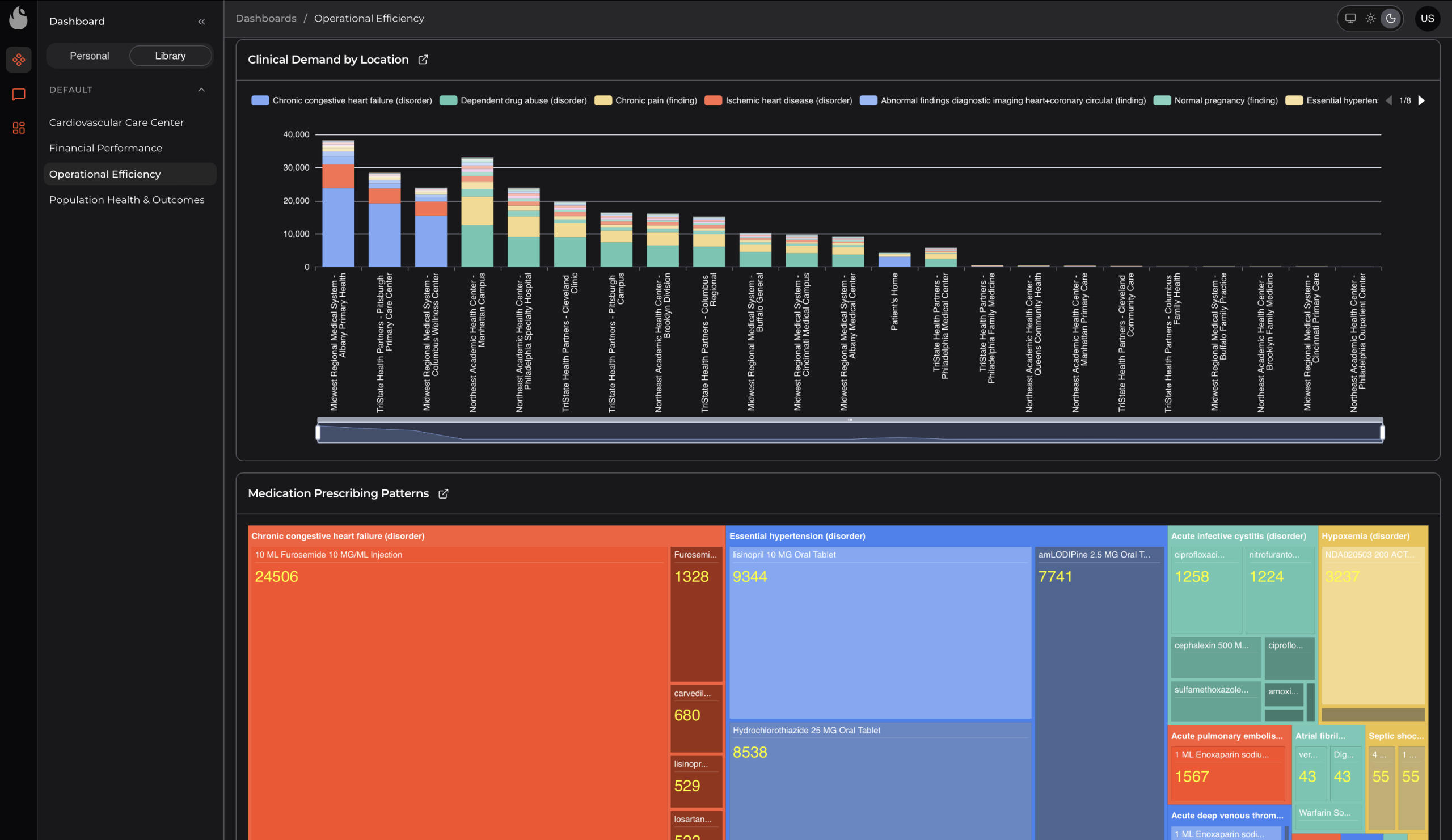
Kodjin Analytics is an AI-assisted analytics platform that helps population health, care management, and clinical operations teams, as well as health insurers, identify where patients with chronic conditions need attention. Explore chronic disease pathways, care gaps, and risk through natural language or visual queries. This chronic care management solution is a part of the broader Kodjin Analytics platform.
Designed for:
Population Health Managers Care Coordinators CMOs & Clinical Ops Leaders Quality & VBC Leaders Head of Analytics & Data TeamsManaging large populations with diabetes, hypertension, COPD, heart failure, and other chronic conditions requires teams to continuously identify emerging risks and gaps in care. Those signals are scattered across longitudinal patient histories, from missed tests and medication adherence to recent ER visits and changing clinical outcomes.
Finding those patients manually across a growing population makes it harder for care teams to prioritize where intervention is needed most.
As a chronic care management solution, Kodjin provides an analytics layer that sits upstream of care coordination, where you define and continuously refine the criteria for your high-risk chronic cohorts.
With Kodjin Analytics, chronic care teams can:
Kodjin Analytics tells you who in your chronic population needs attention, and why. Most software for chronic care management coordinates care once patients are flagged. With Kodjin, teams can revisit risk criteria throughout the year as patient data and clinical priorities change.

Define and refine high-risk chronic cohorts yourself, in plain language. Kodjin Analytics lets you track disease progression across the whole population and explore how patient cohorts change as new data becomes available without waiting for a data team. Explore results immediately and ask follow-up questions as new patterns emerge.

Focus attention where it may be needed most. Kodjin Analytics shows who moved into risk, who has an open care gap, and who is due for personalized outreach, so your care coordination targets the right people first instead of working through the entire panel one by one.

See where chronic care outcomes are falling short and investigate why. Explore population-level trends, care gaps, disease progression, and variation across cohorts without waiting for another report. Kodjin Analytics lets you move from a high-level clinical signal to the patient populations behind it.

Reduce avoidable utilization with one consistent view across facilities. Identify which chronic patients show rising utilization and where care variation is driving costs, then route the right patients to the right services with enough context to act early.

Connect chronic care performance to financial outcomes. Track care-gap closure and adherence alongside quality measures and shared savings, and see which care pathway decisions affect total cost of care so that you can prove performance across value-based arrangements with confidence.

Spend less time assembling data, more time enabling care. Kodjin’s semantic layer eliminates manual joins across EHR, registry, and claims systems. Domain experts can run cohort and care-gap queries themselves, leaving your team more time for analysis.
Three in four U.S. adults have at least one chronic condition, and over half have two or more; chronic diseases are leading drivers of the nation’s $5.3 trillion in annual health-care costs, much of it through avoidable acute care.
Kodjin's chronic care management technology helps care teams see which chronic patients meet the risk criteria their clinicians define, well before an ER visit. By connecting appointment history, clinical signals, and social determinants, organizations can surface the highest-need patients first and reach out early.
Fewer avoidable admissions, clearer priorities for care coordinators, and better continuity of care.

Just 5% of people account for nearly 50% of total U.S. health-care spending, driven largely by the growing number of patients living with three or more chronic conditions, a high-risk group that shifts constantly and that a single, static model misses.
Because domain experts own the cohort logic, the definition of “high-risk” is refined as the population and evidence evolve, rather than being frozen between budget cycles. Kodjin Analytics lets clinicians build cohorts and learn from the patterns they find in the data while keeping every adjustment governed and auditable.
Targeting that improves over time, and a tailored outreach strategy for each cohort.

Care gaps drive the quality scores that money now follows. CMS builds Medicare Advantage Star Ratings in part from HEDIS care-gap measures, and quality bonus payments tied to those ratings will total at least $12.7 billion in 2025, with about three in four MA enrollees in plans that earn a bonus.
Kodjin Analytics continuously evaluates your chronic population against care-gap criteria, so missed labs, overdue screenings, and adherence lapses are visible the moment they occur. The platform connects the clinical signals behind each gap, turning closure into a daily workflow rather than a year-end scramble.
Gaps are closed before they become emergencies, and teams see clear gains in performance on quality measures.

Most of what determines a chronic patient’s trajectory happens outside the exam room. The National Academy of Medicine estimates that medical care accounts for only 10-20% of modifiable health outcomes, while the remaining 80-90% comes from social determinants of health.
Kodjin lets care teams layer social and behavioral signals onto clinical and claims data, so a clinically stable patient who is food-insecure or lacks reliable transport can be flagged for outreach before that risk turns into an avoidable admission. Cohorts can be defined on these combined factors in plain language, without engineering work.
Earlier outreach informed by clinical and social risk, fewer avoidable admissions, and more equitable chronic-care outcomes.

Fewer Avoidable Hospitalizations and ER Visits

Continuously Corrected Risk Targeting
Care-Gap Closure as a Daily Workflow
Social and Behavioral Risk
Explore how a chronic care management platform can support your daily workflows and priorities. Share your key challenges and requirements, and we’ll focus the conversation on what matters most to your organization.
Chronic care strategy shouldn’t live with whoever owns the data. Kodjin helps clinical leaders, care coordinators, and population health teams independently define and refine risk targeting.

Traditional chronic care tools work with a single registry or care management module in isolation. But the questions that matter most — "Which CHF patients show signs of worsening disease control?", "Who is overdue and rising in risk?", "Is this cohort definition still right?" — require connecting clinical data to claims, medication history, and social context. Kodjin Analytics connects those sources through a semantic layer, so teams can apply consistent definitions across analyses.
What Kodjin Analytics Does
What It Means for Your Organization
Unifies EHR, registry, claims, and SDOH data
One view of each chronic patient, not a record scattered across systems
Lets domain experts define cohorts in plain language
Clinicians can set cohort criteria without asking engineers to code each change
Structures data around clinical meaning
Teams work with concepts like “overdue for HbA1c” or “frequent ER use in the last 90 days”
Computes care-gap and quality logic natively
Gap closure and CCM documentation without hand-built CQL services
Spans reporting through care team workflows
One platform for both regulatory reporting and day-to-day care team work
Keeps risk parameters under continuous review
Risk targeting stays current and governed, not frozen between cycles
Supports real-time and batch data ingestion
Care gaps and risk signals reflect today's status, not last month's extract
Supports FHIR and other healthcare data standards
Chronic-disease data flows cleanly across systems, registries, and partners
Chronic disease management is a strong use case for Kodjin Analytics. The same platform and data foundation also support the clinical, operational, and research analyses below.
Effective chronic disease management requires clean data flowing between EHR, registry, and operational systems. Kodjin supports the full data lifecycle from ingestion to AI-powered exploration.
Use Kodjin as a central platform to unify healthcare data across systems, creating a trusted foundation for interoperability, governance, and regulatory compliance.
Build AI-powered chronic care applications, risk alerts, care-gap dashboards, and personalized outreach tools on top of Kodjin's semantic layer, using universal AI components and any LLM provider.
Kodjin helps chronic care programs refine risk criteria before they guide outreach. It lets your team define and continuously refine the risk parameters that determine which chronic patients need attention, track care gaps and adherence against live data, and feed those insights into both value-based reporting and care coordination workflows.
FHIR preserves the relationships between conditions, medications, encounters, and observations rather than flattening them into disconnected fields. Kodjin supports FHIR alongside other healthcare data standards, and its semantic layer keeps that clinical meaning when data from EHRs, registries, and claims is combined. That is what enables a chronic care management platform to compute cohorts, surface care gaps, and support CCM reporting without custom engineering for each new question.
Yes. Kodjin continuously evaluates your chronic population against care-gap criteria, so overdue labs, missed screenings, and adherence lapses appear the moment they occur. Your team asks in plain language which patients are overdue for a test, or which carry a rising risk, and gets prioritized lists from live data, turning gap closure into a daily workflow with measurable success.
Risk stratification in Kodjin is defined by your domain experts, not hard-coded by engineers. Clinicians build cohorts and learn patterns directly from the repository, then push refined parameters into coordination. Because the logic is owned by the people delivering care, “high-risk” is corrected continuously as the population and evidence change, and every adjustment is governed and auditable.
Kodjin supports the documentation side of CMS CCM. Because every metric is computed from the same semantic layer, eligibility (patients with two or more chronic conditions expected to last at least 12 months that place them at significant risk) and the reporting behind a claim are consistent, reproducible, and audit-ready. This chronic care management solution gives compliance and billing teams a transparent trail per query, so CCM services are easier to substantiate. Kodjin provides the data and reporting, and your billing system files the claim.
Yes. Value-based arrangements depend on seeing how chronic-disease success connects to financial outcomes. Kodjin brings population health data, utilization patterns, quality measures, and cost data into a single chronic care analytics layer. Leaders can track shared savings, model risk exposure, and analyze cost-per-member trends alongside clinical quality, making the best chronic care management software a strategic tool for organizations moving toward risk-based payment models.
Please leave your email to get Kodjin Analytics Solution Brief
We have sent a copy to your email
Please leave your email to get Kodjin Data Platform Solution Brief
We have sent a copy to your email
Back to website content