Every healthcare data consolidation project begins with one integration that works well enough. Trouble arrives around the fifth, when most systems give four different answers to the same question about the same patient.
This article is written for product and technology leaders whose digital health platform has to integrate multiple EHRs or data systems: healthcare IT vendors, multi-practice networks, care management companies, and analytics teams at health plans and payers.
It explains why point-to-point EHR integration stops scaling, and what financial, operational, and clinical data layers must do before applications can be built on top of it. Further sections cover the architectural decisions that quietly set your time-to-value. The last part weighs ready Kodjin solutions against a custom build.
To build a scalable digital health platform, an organization consolidates data from every EHR and source system into one standardized data layer, governs that layer centrally, then builds applications against it instead of against each source. Done properly, the second integration costs a fraction of the first, because the expensive work happened once underneath.
The problem this article deals with is narrow and expensive. Hospitals and practices can now send and receive clinical records, yet much of what arrives still has to be re-entered or reconciled by hand before anyone can use it to gain insights and make decisions.
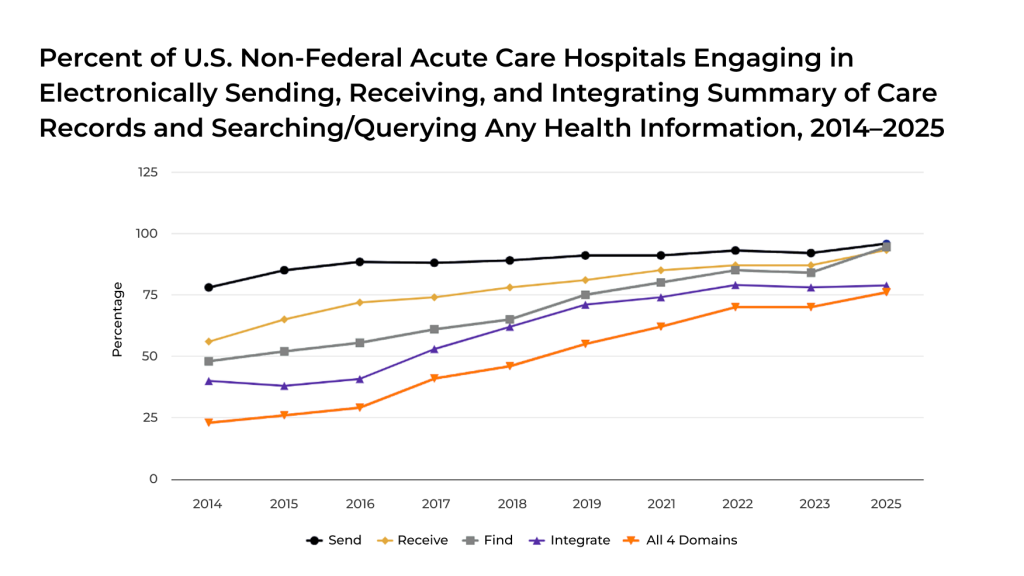
Federal data on US hospitals shows that gap clearly. By 2025, 96% of US non-federal acute care hospitals could send a summary of care records electronically, and 94% could query outside sources for patient information, according to ASTP/ONC. The share that integrates an incoming record into the EHR without manual entry stood at 79%, a number that has barely moved since 2022. Moving data turned out to be the solvable part.
Routine use is a further step down. The ASTP/ONC data brief published in 2024 found that 71% of hospitals had routine access to clinical information from outside providers, while 42% said clinicians routinely use it when treating patients.
Demand keeps climbing regardless: in 2025, 22% of US healthcare organizations had deployed domain-specific AI tools, seven times the 2024 share, according to Menlo Ventures. When twelve practices code the same lab test in three different ways, a model inherits the inconsistency along with the records. Analytics across the network stops being trustworthy well before anyone notices.
Kodjin Data Platform by Edenlab was built around one specific gap: clinical data reaches the organization from many systems, but it cannot be used together until it shares one structure and one set of codes, with every record tied to the right patient.
Kodjin Data Platform closes that gap as a FHIR-native healthcare data platform assembled from separate solutions, so a team can standardize ingestion, terminology, storage, and access control without adopting an entire stack on day one. The sections below cover what the foundation must do and how the build-versus-assemble decision usually plays out.
Highlights:
- Electronic exchange is close to universal, with 96% of US hospitals sending care records electronically and 94% querying outside sources as of 2025. Integration of what arrives stalls at 79%, unchanged in three years.
- Routine exchange across all four domains reached 43% of hospitals in 2023, and 22% among independent hospitals, per the ASTP/ONC data brief published in 2024.
- A first Kodjin Data Platform deployment covering a narrow use case typically runs months, compared with several quarters to build a foundation from scratch.
Why Does Point-to-Point EHR Integration Stop Scaling?
Multi-EHR integration built point-to-point grows faster than most budgets. Four source EHRs feeding six downstream consumers means twenty-four interfaces, each carrying its own assumptions about field names, units of measure, code systems, and what an empty field means. Every change on either side touches several of them. Teams rarely plan for this; they end up dealing with it.
The deeper problem is that every system describes the same clinical facts differently. Formats are only part of it: sources send HL7 v2 messages, C-CDA documents, FHIR API requests of uneven maturity, or plain CSV exports, and each one needs its own handling. The bigger issue is meaning. Picture a network of twelve practices on four different EHRs.
One practice codes lab results using LOINC. The next uses local codes from a mapping file last updated in 2021. At a third practice, results sit as free text in a note. When leadership asks which practice has the highest readmission rate, the answer cannot be trusted, because the practices are not counting the same thing. No dashboard fixes that after the fact, and each new EHR integration adds to the cost of reconciling the numbers by hand.
The events all arrive. What doesn’t arrive is shared meaning, and nothing built downstream can supply it later.
The national numbers show the same split. Sending and finding both climbed above 90% by 2025, while integration held at 79%. Connections exist. What is missing is data arriving in a shape somebody can act on.
Normalization gets deferred to phase two in nearly every roadmap. Phase two usually begins the week a manager asks why two reports disagree.
A unified data layer is what makes ingested data reusable by the next application you integrate, without another mapping project. That is the difference worth designing for.
What Business Opportunities Does a Unified Data Layer Open?
The same data foundation serves healthcare organizations and tech product developers. The business intent usually falls into one of three groups:
- Proactive, data-driven decision-making. IT vendors, multi-practice network executives, care teams, and researchers cut the analytics cycle from weeks to minutes and query in plain language, no matter the data model. Population health analytics and a clinical trial recruitment platform can get information from one centralized clinical data repository, and EHR or RCM vendors can embed a healthcare analytics platform as a white-label feature.
- Consistent data exchange with seamless integrations. One source of truth for standards-based, bidirectional exchange, built on a FHIR-native and data-agnostic core with structured terminology. In a multi-practice data platform, new organizations join through existing mappings.
- Business and clinical process automation around connected data. Turn data exchange into action across care coordination, referrals, monitoring, patient engagement, and other workflows. A care management platform can use current patient data to trigger and support processes across systems instead of relying on manual hand-offs and disconnected workflows.
All three rely on the same capabilities, listed below.
What Should Be Under the Hood of a Digital Health Platform?
Below, we break down the core capabilities needed to build a scalable digital health platform. Kodjin Data Platform supports this functionality out of the box and can serve as the foundation for your platform. Alternatively, Edenlab can build a custom solution around your requirements, using selected pre-built components to reduce development time and effort.
- Ingestion at two speeds. Batch loads handle history and backfills. Event-driven feeds handle anything a clinician or an automated alert depends on within the hour.
- Mapping and transformation into a canonical model. The real input list is messier than the architecture diagram suggests: HL7 v2 messages, C-CDA documents, FHIR APIs of varying maturity, CSV exports from a practice management system, occasionally a database dump.
- Terminology normalization. SNOMED CT, LOINC, ICD-10, RxNorm, plus the local code sets every organization keeps and rarely documents. This step takes more time than anyone budgets for, in nearly every project.
- Patient identity resolution. Source identifiers do not travel. A patient seen at two practices inside your own network arrives as two people until you decide how linkage works and who reviews the uncertain matches. Without that decision, there is no longitudinal patient record to build on.
- Storage. A repository that holds standardized records and serves them back through an API your applications can query at runtime. An analytics warehouse that reports read from overnight cannot fill this role. In practice, this part works as a healthcare API platform for every product built on top.
- An analytics store alongside it. Transactional record access and population-level healthcare data aggregation have different access patterns. Running both off one engine constrains one of them, usually the second.
- Governance enforced by the platform. Role-based access, consent handling, audit logging, encryption in transit and at rest. Built once underneath, rather than reimplemented in each application.
- A healthcare semantic layer that speaks in business concepts – defining readmissions, care gaps, eligible cohorts, and cost per episode. This is what analysts query, and what an LLM needs in order to answer a clinical or financial question correctly.
- AI enablement layer. Longitudinal, semantically enriched data views that models can reason over, plus controlled interfaces for connecting LLMs and AI agents to the platform. Typical examples are retrieval over patient records and tool access to the semantic layer. Guardrails apply the same access rules here as everywhere else in the stack. This layer is what turns standardized records into AI-ready healthcare data. Without it, every AI feature ends up with its own data pipeline and its own security review.
Which Model Should You Standardize On: FHIR, openEHR, OMOP, or Another?
FHIR is a natural choice for many digital health platforms. Regulation already pushes in that direction, through ONC certification criteria and TEFCA in the United States, and through ISiK and Gematik requirements in Germany.
Other models earn their place for specific jobs. OpenEHR gives deeper clinical modeling where archetypes are already governed. OMOP suits observational research and comparative studies.
Plenty of mature platforms keep FHIR as the exchange and storage model while projecting an OMOP view for research teams. If you serve several organizations, model flexibility stops being academic: the ability to run analytics across FHIR, openEHR, OMOP, and legacy structures decides which clients you can onboard without a rewrite.
Kodjin Data Platform can work with any data standard, regardless of the underlying data model.
Which Architectural Decisions Set Your Time-to-Value?
Each row below describes a shortcut that produces a working demo weeks earlier. They tend to come up at the same time, usually with the second or third organization onboarded.
| Decision | The shortcut | What it costs later |
|---|---|---|
| Canonical model | Store each source in its own schema, reconcile inside reports | Every new client turns into a rebuild of the reporting layer |
| Terminology | Map codes per integration, inside the pipeline | Metrics stop being comparable across organizations, with no single place to fix a value set |
| Patient identity | Trust the source system identifier | Duplicate patients, broken longitudinal views, care gaps counted twice |
| Access control | Enforce permissions in each application | Multi-tenant deployment and audit preparation become manual work |
| Storage | Analytics warehouse only, no transactional API | Applications cannot read or write patient data at runtime |
| Latency | Nightly batch for everything | Alerting and care coordination use cases stay out of reach |
Should You Build Custom or Assemble From Ready Components?
Teams weighing a build vs buy healthcare data platform decision usually picture two options. In practice, there are three routes to a working healthcare data integration platform, and the right one depends less on budget than on how unusual your requirements actually are.
| Route | Where it fits | Main risk |
|---|---|---|
| Fully custom or with open-source parts | You have FHIR engineers on staff and your data model is genuinely unconventional | The team ends up operating infrastructure instead of building product. Terminology and identity work is routinely underestimated by a factor of two |
| Ready components, customized to your case | The requirements are recognizable healthcare problems: multi-source ingestion, a FHIR repository, terminology management, analytics on top | Fit has to be verified early. Check extensibility and the deployment model before committing |
| Custom development on top of an end-to-end flexible data platform | The product itself is the differentiator and the data layer must follow a specific workflow | Cost and timeline depend on how much of the foundation is reused rather than rewritten |
Kodjin Data Platform can be deployed as individual solutions or as a complete end-to-end platform as a backend for your digital health platform:
- Kodjin FHIR Server holds the FHIR data repository, with SMART on FHIR and dynamic profiling available out of the box.
- Kodjin Data Mapper converts HL7 v2, C-CDA, CSV extracts, and proprietary formats into FHIR resources.
- Kodjin Terminology Service keeps value sets and code system mappings in one governed place.
- Kodjin ELT Solution orchestrates batch and near-real-time flows through a low-code interface.
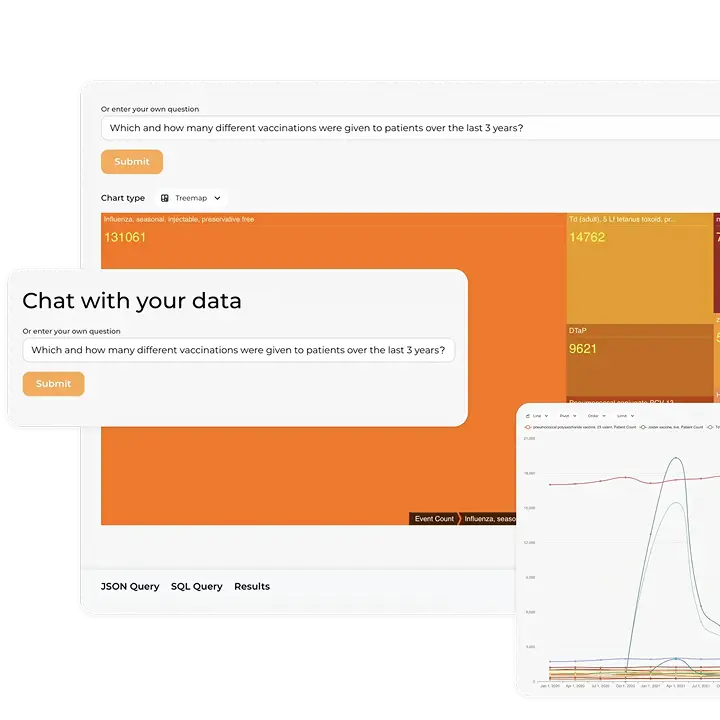
- Kodjin Analytics brings the semantic layer that becomes the single governed definition of the organization’s measures, so dashboards, exports, and AI queries all resolve against the same logic — a foundation that enables a single source of truth. Conversational analytics lets users ask questions in natural language and receive charts and tables; every generated query is validated against the semantic metadata before execution, keeping self-service anchored to governed logic. Pathway analysis maps how patients move from diagnosis through treatment, visualized as care pathways, surfacing trajectories and variation, and enabling precise cohort identification by event sequence — useful for trial recruitment and outcomes research.
Teams take the pieces they lack and keep what already works. A platform team with solid ingestion may need only the repository and the terminology service. If a team starts with spreadsheets and four EHRs, most of the stack becomes relevant. Because the components are modular, the first deployment doesn’t require adopting everything at once. The same logic applies to custom digital health platform development: Edenlab engineers extend the components where a product needs behavior the standard pieces do not cover.
What Can You Build Once the Unified Data Layer Exists?
Once records land standardized and governed, applications stop being integration projects and start being product decisions.
- Care management across the network rather than inside one EHR, with risk stratification that runs on unified patient data and sees every encounter a patient had using pathway analysis.
- Population health and quality work that identifies care gaps months before reporting season rather than during it.
- Financial analysis where denial patterns are comparable by payer and by practice, because the underlying codes mean the same thing everywhere.
- Clinical trial recruitment against structured eligibility criteria. Inadequate accrual ended or suspended close to a third of trials over the decade to 2021. One Kodjin client attributed more than $750K in additional provider revenue to a single trial.
- Patient engagement apps and SMART on FHIR applications built against one API instead of one integration per customer.
- AI assistants that reason over verified business concepts and return answers traceable back to source records, under the same access rules as the data underneath.
How Do You Roll It Out Without Replatforming Everything?
Hospitals and networks assembled over decades cannot be replatformed in a year, and a digital health platform doesn’t need to be. The workable pattern for healthcare platform development is narrow and vertical.
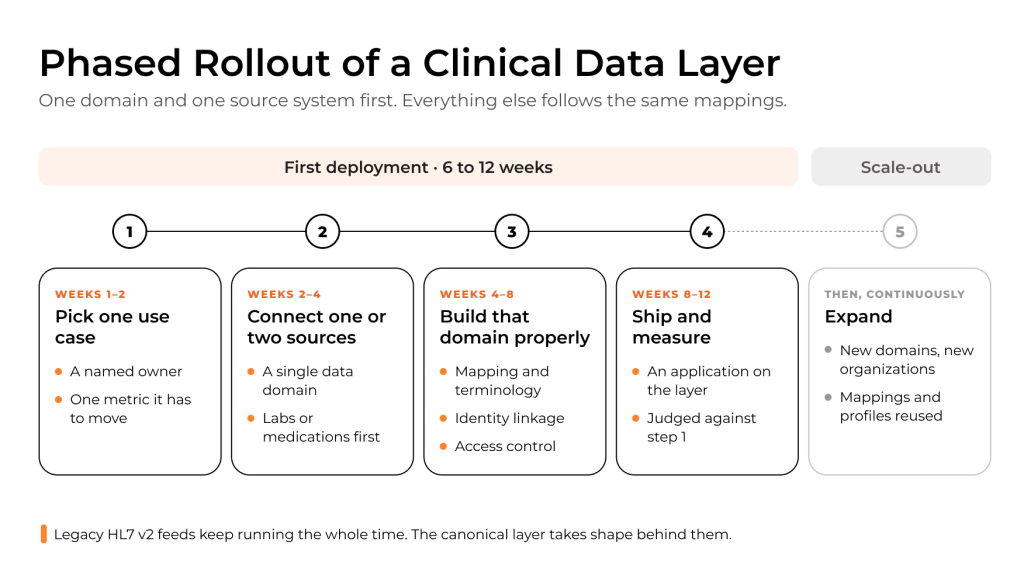
- Choose one use case with a named owner and an attached metric. A platform without a first metric tends to expand until nobody can say whether it worked.
- Onboard one or two source systems and a single data domain. Medications and labs are common starting points because the terminology pain surfaces immediately.
- Build that domain properly: mapping, terminology alignment, identity linkage, access control. Resist the temptation to widen scope while this is unfinished.
- Expand by domain and by organization, reusing mappings and profiles instead of negotiating them again.
Wrapping Up
A digital health platform is only as extensible as the data layer beneath it. Care management, quality reporting, trial recruitment, and conversational AI all read from the same foundation. Standardize it once, and each new capability becomes a product decision. Skip that step and each new capability becomes another integration project under a different name.
The sequence matters more than the tooling. Standardize one data domain before widening the scope. Put governance into the architecture rather than into every application separately. Attach a metric to the first use case, so the platform gets judged on something other than the number of systems connected.
Teams that work in this order usually onboard their third organization faster than their first, while teams that defer normalization spend the same effort later, at a higher cost, with customers watching.
AI raises the stakes on all of it. A model answering a question about readmission risk or open care gaps is only as reliable as the semantic layer it reads from, and a fluent wrong answer is harder to catch than a missing one. Organizations that invest in AI features before terminology alignment and identity resolution are, in practice, investing in confident errors. The order of work has not changed because the technology did.
The choice between building custom and assembling ready components is rarely all or nothing. Most platforms reuse a standardized repository, mapping tooling, terminology management, and access control, then reserve custom healthcare software development for the differentiating product on top. Kodjin is built around this pattern, which is why a first deployment is usually counted in weeks rather than quarters.
If you’re planning to build a digital health platform or deciding how much of the data layer to build yourself, our team is here to support you. Feel free to contact us.
FAQs
What is a unified data layer in a digital health platform?
A unified data layer is a standardized, governed repository that sits between source systems and the applications built on them. It ingests records from EHRs and other sources and normalizes them into a canonical model such as FHIR, linking each record to the right patient. Applications and analytics then read from this one layer through APIs instead of connecting to every source separately.
How can a digital health platform integrate data from multiple EHR and EMR systems?
A digital health platform integrates multiple source systems by routing every source into one clinical data layer instead of building a point-to-point interface for each application. Mapping tools convert HL7 v2 messages, C-CDA documents, FHIR APIs, and flat-file exports into one canonical model on ingestion, which is where HL7 FHIR integration usually happens.
Terminology normalization and patient identity matching follow, so data from different EHRs becomes comparable. Each new source then needs one connection to the layer, not one per consumer.
What is the difference between EHR integration and a centralized clinical data repository?
EHR integration moves data between systems, while a centralized data repository stores that data in one standardized, governed form that many applications can reuse. An integration can deliver a lab result on time and still leave it in the source system’s local codes. A repository normalizes terminology and resolves patient identity once, so reports and applications built on it agree with each other. Scalable platforms usually need both, with integrations feeding the repository and the repository serving the products.
Why use FHIR for a healthcare data platform, and what problems does FHIR not solve by itself?
FHIR gives a healthcare data platform a widely adopted data model and API standard, backed by regulation such as ONC certification in the US and ISiK in Germany. It makes records easier to exchange and lets SMART on FHIR apps connect without custom interfaces.
On its own, FHIR does not map local codes to SNOMED CT or LOINC, and it does not match the same patient across sources. It also has no notion of business metrics like readmission rate or care gaps, which is why a FHIR data platform needs a terminology service, identity matching, and a semantic layer around it.
How can a unified data layer support care management, analytics, and AI?
A unified data layer supports care management, analytics, and AI by giving all of them the same standardized, governed records. Care management tools see every encounter a patient had across the network, not only the data inside one EHR.
Analytics produce metrics that can be compared across practices, because codes mean the same thing everywhere. AI assistants read verified business concepts from the semantic layer, which keeps their answers traceable to source records.
How can multi-practice networks create longitudinal patient records across different EHRs?
Multi-practice networks create longitudinal patient records by consolidating data from each EHR into one clinical data layer and linking the records that belong to the same person. Source identifiers rarely match between practices, so patient identity matching relies on demographics and other attributes, with uncertain matches sent for human review. Terminology normalization then makes the linked records comparable over time. The result is one timeline per patient, whichever practice the patient visited.
Can the same healthcare data platform support research and clinical trial recruitment?
Yes, the same healthcare data platform can support research and clinical trial recruitment once its data is standardized and governed. Structured eligibility criteria run against normalized records to find candidate patients across sites, and many platforms project an OMOP view from FHIR data for observational research. Consent handling and access control need to cover these research uses as well as clinical ones. One Kodjin client attributed more than $750K in additional provider revenue to a single trial.
Should we build a custom digital health platform or use ready-made healthcare data components?
Building a custom digital health platform from scratch makes sense when a team already has FHIR and data engineering expertise and the requirements are genuinely unusual. When the problems are familiar ones, such as multi-source ingestion or terminology management, ready-made components remove most of the groundwork.
Many teams combine the two approaches, using ready components for the data layer and custom development for the product that sets them apart. Components that can be extended and deployed on the team’s own infrastructure keep both options open.
How can Kodjin accelerate development of a custom digital health platform?
Kodjin accelerates custom digital health platform development by providing modular out-of-the-box solutions: a FHIR server, a data mapper, a terminology service, ELT pipelines, and analytics with a semantic layer and AI capabilities. Teams adopt only the pieces they lack and build their own product on top.
A first deployment covering a narrow use case typically takes six to twelve weeks, compared with several quarters for a foundation built from scratch. Edenlab engineers can also extend the components where a product needs custom behavior.