Healthcare organizations already have vast amounts of pricing data. The challenge is turning it into usable, shareable information. Large file volumes, inconsistent formats, and fragmented data sources complicate this process. The new CMS price transparency rules aim to address this challenge.
On October 5, 2026, CMS and the Departments of Labor and the Treasury finalized the CMS Price Transparency Rules 2026, formally the Transparency in Coverage final rules (CMS-9882-F).
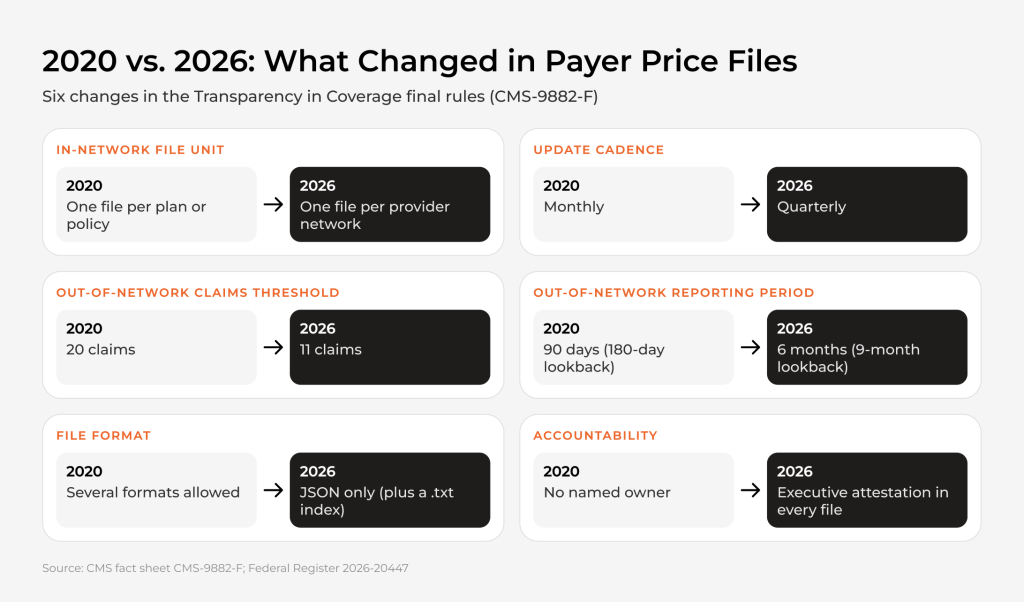
The update changes how health plans publish negotiated rates. Files will be organized by provider network and posted quarterly in JSON. Rates for services a provider is unlikely to perform must be removed, and a named senior executive must attest to the completeness of the data.
For payers, this is a CMS Price Transparency compliance project with fixed deadlines. Providers also face existing price transparency obligations and must ensure their own disclosures meet CMS requirements. At the same time, the new rules create opportunities for payers, providers, and healthcare IT vendors to use more reliable public data for benchmarking, contract negotiations, and product development.
The organizations that gain the most will join the new files with claims and provider network data and reuse them well beyond the compliance report.
This guide explains what payers, healthcare providers, and healthcare IT vendors need to do to adapt to the new CMS requirements, and how Kodjin Data Platform helps them navigate these changes without disrupting their existing infrastructure. We also explore how they can go beyond compliance to unlock new business use cases and turn complex pricing data into actionable analytics insights.
Highlights:
- The rule takes effect on December 7, 2026, and the first restructured In-network Rate and Allowed Amount files are due on April 1, 2027.
- Payers move to one file per provider network with quarterly updates in a single JSON format. New contextual files explain how the rates were prepared.
- Providers and healthtech vendors get cleaner public data for reimbursement benchmarking and pricing intelligence products.
What Changed in the 2026 CMS Transparency in Coverage Rules?
The 2026 CMS Transparency in Coverage rules keep the core obligation introduced in 2020. Plans and issuers must still publish negotiated in-network rates and historical out-of-network allowed amounts in machine-readable files.
What changes is the structure of that data and the accountability behind it. Transparency in Coverage 2026 reorganizes files around provider networks and cuts the publishing cadence from monthly to quarterly. It also adds files that explain how rates were prepared and makes a named executive responsible for accuracy.
Why the Original Price Transparency Rules Were Not Enough
The 2020 rules made enormous amounts of pricing data public. Using that data proved much harder than publishing it. The 2026 rule is largely a response to four practical problems.
Problem 1. Data Was Available but Difficult to Process
The volume of machine-readable healthcare pricing data was the first obstacle. Within six months of the July 2022 launch, Turquoise Health counted about 630 TB of payer data online, holding roughly 78 billion price records. Hospital files from the same period added up to about 3 TB. These files are often difficult to locate and process because of their size, making it far harder for the transparency data to be useful.
Problem 2. Pricing Data Often Lacked Sufficient Context
A query for one CPT code could return several rates for the same provider without saying which network or insurance product each rate belonged to. As a result, technically accessible data could still produce misleading comparisons. This is why the 2026 rule adds network names and identifiers to the files, along with the product type of each plan.
Problem 3. Datasets Contained Duplicates, Errors, and Irrelevant Records
“Ghost rates” for services a provider would never perform. As one healthtech executive put it in industry coverage, nobody needs to know what a heart transplant from a podiatrist costs, because podiatrists do not perform them. Under the 2026 rules, plans must exclude such combinations and publish the logic they used to do so.
Problem 4. Published Rates Did Not Necessarily Reflect What an Individual Patient Would Pay
Even when a negotiated rate is available, a patient usually cannot determine their actual out-of-pocket costs from it. That calculation depends on the plan design, the remaining deductible, coinsurance and copayments, and whether the service is billed as part of a larger episode.
CMS declined to require consumer-friendly cost summaries in the public files for this reason.
Public pricing files and personalized cost-sharing tools answer different questions. A negotiated rate tells you little about the paid amount or the full episode cost, so any serious healthcare price analytics product has to keep these numbers apart.
New CMS Price Transparency Requirements: What Healthcare Organizations Must Do
Under Transparency in Coverage 2026, CMS machine-readable files form a set of six related outputs.
Two are primary pricing files, and two are new contextual files. One helps people find all the others, and one covers prescription drugs on its own schedule.
Updated Machine-Readable File Requirements
| File Type | Purpose | Technical Changes |
| In-network Rate File | Negotiated rates between plans or issuers and in-network providers | One file per provider network; network name, network ID and product type required; unlikely provider-service combinations excluded; quarterly updates; Schema 3.0 |
| Out-of-network Allowed Amount File | Historical allowed amounts paid for out-of-network services | Aggregated by market type (large group, small group, individual, self-insured); 11-claim threshold; six-month reporting period with a nine-month lookback; product type added; quarterly updates |
| Taxonomy File | Explains which provider taxonomies or adjudication rules were used to decide which rates appear in each In-network Rate File | New contextual file, published for each In-network Rate File |
| Utilization File | Lists providers that received reimbursement for at least one covered claim in the most recent plan year that ended six months before posting | New contextual file, published annually for each In-network Rate File; a yes/no signal, not claim volumes |
| Text File (.txt) | Points to the location of all machine-readable files and gives contact information, including a monitored email address | New file placed in the root folder of the plan’s or issuer’s website; paired with a homepage footer link |
| Prescription Drug File | Prescription drug pricing information | Separate timeline: new schema developed from November 2026, first disclosure December 2027, monthly thereafter |
Taxonomy and Utilization files add the context needed to interpret the primary pricing files.
The Taxonomy File shows why a rate is present (or absent) for a given provider type. The Utilization File shows whether a provider in the network billed the plan during the reference period.
Read together with the In-network Rate File, they let an analyst separate rates in active use from rates no provider has billed.
How Kodjin Data Platform Can Support These Requirements and More
For teams that build and run the pipelines, six changes carry most of the engineering effort.
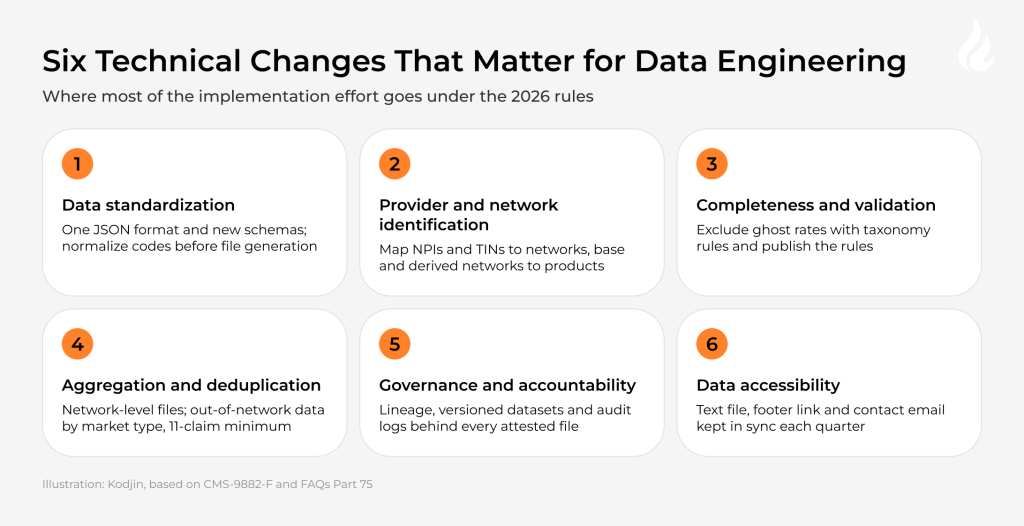
Most of the work described above is data engineering: collecting rates from contract systems, normalizing them, linking them to provider network data, validating them, and keeping an auditable history.
Kodjin is the healthcare data platform we at Edenlab built for this type of work. It covers ingestion, transformation, terminology management, data modeling, and governance. We also add a healthcare-native semantic layer and AI-assisted healthcare analytics on top of the same data architecture.
For a health plan, the combination works as a payer data platform. For a vendor, it is a healthcare data analytics platform to build products on.
Two points are worth clarifying.
First, CMS does not require FHIR® for Transparency in Coverage files; the required format is JSON defined by CMS schemas. Kodjin works with FHIR and non-FHIR data alike, so financial and pricing datasets do not need to be converted into FHIR resources. FHIR becomes useful when pricing is linked to clinical data, and that is where the Kodjin FHIR Server can play a role.
Second, Kodjin provides data infrastructure. It does not certify compliance or publish files on a payer’s behalf. File generation against the CMS schemas, along with the related validation and attestation workflows, is configured on top of the platform, together with the client’s team or our healthcare engineering services.
Kodjin: Addressing the Challenge of Making Pricing Data Usable
| Data Engineering Challenge | Kodjin’s Contribution |
| Pricing data stored across multiple systems | Data ingestion and healthcare pricing data integration from contract management, claims, provider directory, and network management systems |
| Inconsistent source data formats | Data mapping, transformation, and pricing data normalization across heterogeneous sources (CSV, HL7®, proprietary formats), without mandatory conversion to FHIR |
| Inconsistent codes and terminologies | Terminology management for CPT, HCPCS, revenue codes, NDC, and provider taxonomy codes, including mappings from proprietary codes |
| Complex pricing data relationships | Data modeling that preserves relationships between negotiated rates, billing codes, providers, insurance products and networks |
| Data quality and completeness | Data preparation and validation capabilities that support regulatory QA workflows, such as missing identifiers, duplicate records, and implausible values |
| Large volumes of pricing data | Scalable processing on Kubernetes-based infrastructure in the cloud or on-premises |
| Regulatory file preparation | Reusable, versioned datasets that serve as the input for generating and validating CMS machine-readable files |
Kodjin Beyond Compliance: Advanced Data & Analytics Capabilities
Once rates are cleaned and modeled, the same data can answer business questions. Kodjin Analytics handles this layer.
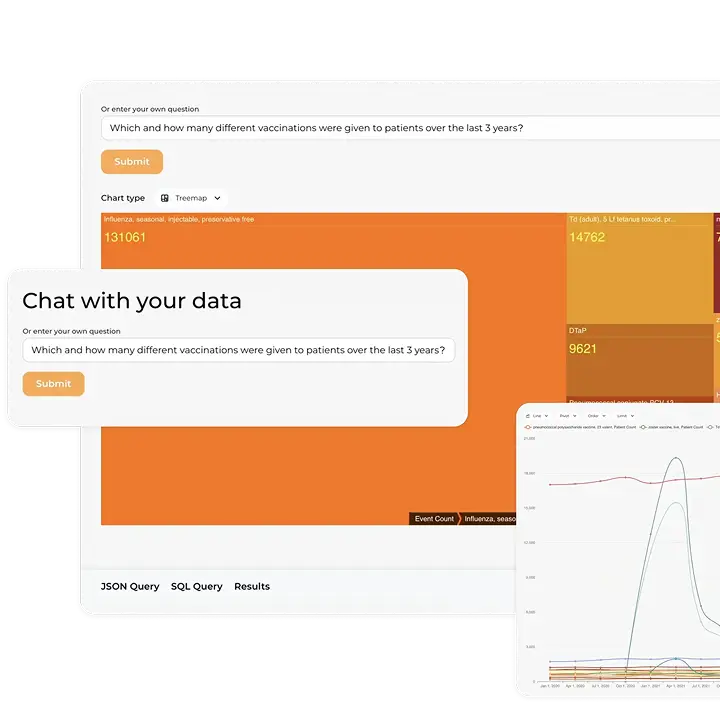
Analysts work with healthcare concepts such as “allowed amount,” “network,” “episode,” or “service line,” defined once in the semantic layer, so they do not need to write SQL against raw tables. Business users can ask questions in plain language and get answers based on those shared definitions. This is how AI-assisted price analytics works in Kodjin.
| Technical Challenge | Kodjin’s Contribution |
| Pricing data integration and comparison | Combine published negotiated rates with internal reimbursement data for consistent comparisons across providers, networks, and services |
| Integration of pricing, claims and utilization data | Bring negotiated rates, claims, utilization, and provider performance data into one analytical environment, backed by a healthcare data warehouse |
| Standardization of financial and clinical metrics | A healthcare-native semantic layer with reusable definitions and relationships across pricing, claims, clinical, and financial data |
| Cross-domain analytical queries | Semantic models that let applications work with healthcare concepts and predefined metrics instead of underlying database structures |
| Linking service-level costs to the patient pathway | Connect pricing with claims, clinical, and administrative data to analyze complete treatment episodes |
| Longitudinal patient data analysis | Link clinical events, resource use, treatment costs, and outcomes across the patient journey |
| Reusable analytics infrastructure | Give healthcare IT vendors ready data models and analytical capabilities for building applications on integrated healthcare datasets |
Build a Reusable Data Foundation Instead of a Compliance-Only Pipeline
A conventional approach to the CMS price transparency requirements is a dedicated pipeline that extracts rates and converts them into the required JSON before publication. That satisfies the disclosure requirement.
However, this approach rarely makes the data reusable. Every analytics project that follows tends to rebuild the same extraction and mapping logic from scratch.
A shared data foundation treats compliance as one consumer of governed, versioned datasets among several.
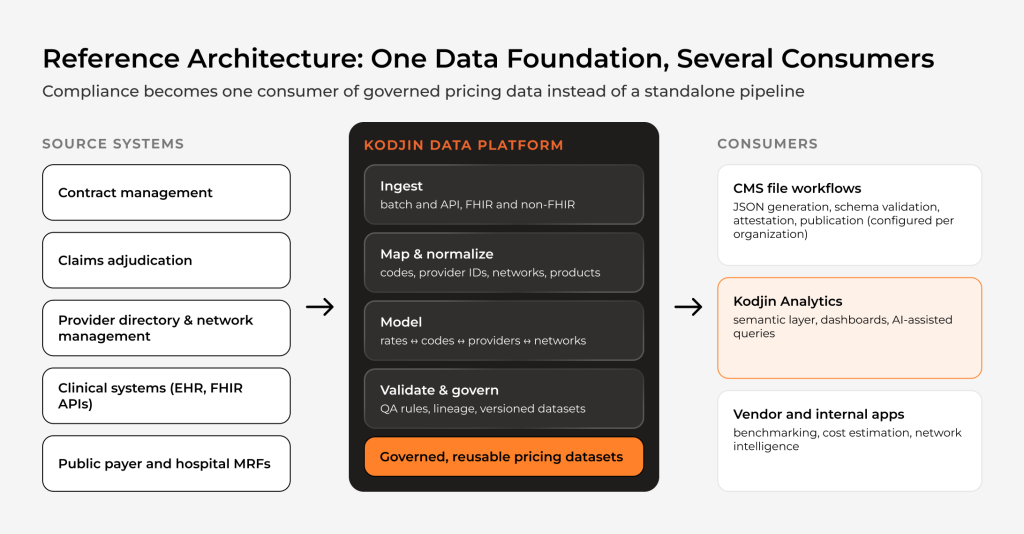
Such a foundation supports:
- Regulatory reporting and CMS file preparation.
- Healthcare price analytics and contract rate benchmarking.
- Cost estimation applications.
- Cost-of-care analytics that combine financial and clinical data.
- Future use cases, such as value-based contract modeling, that nobody has scoped yet.
Kodjin provides much of this foundation ready-made. Its existing integration and transformation capabilities reduce the engineering effort that regulatory data preparation would otherwise require. Its semantic layer and analytics let organizations combine pricing data with financial, clinical, and administrative information.
Source mappings and QA rules still need to be set up for each organization, but the underlying infrastructure does not have to be built from scratch.
New Business Opportunities Created by Healthcare Price Transparency
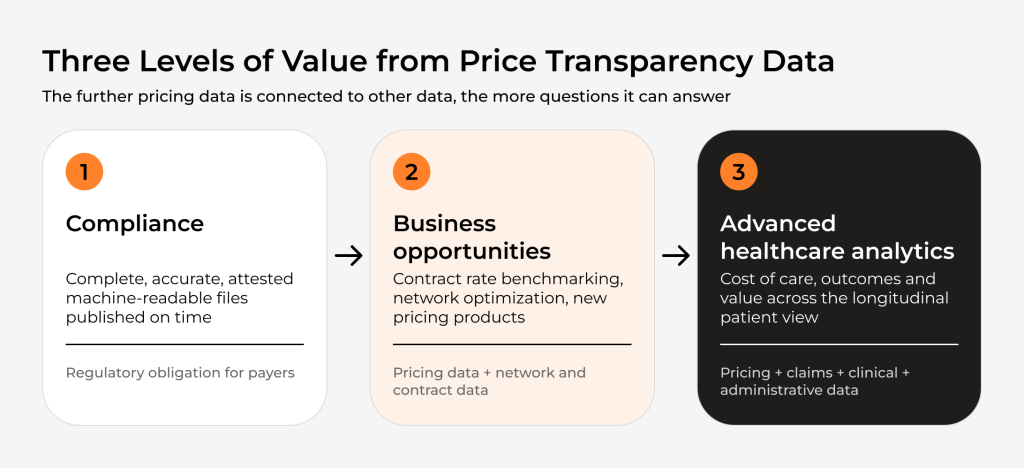
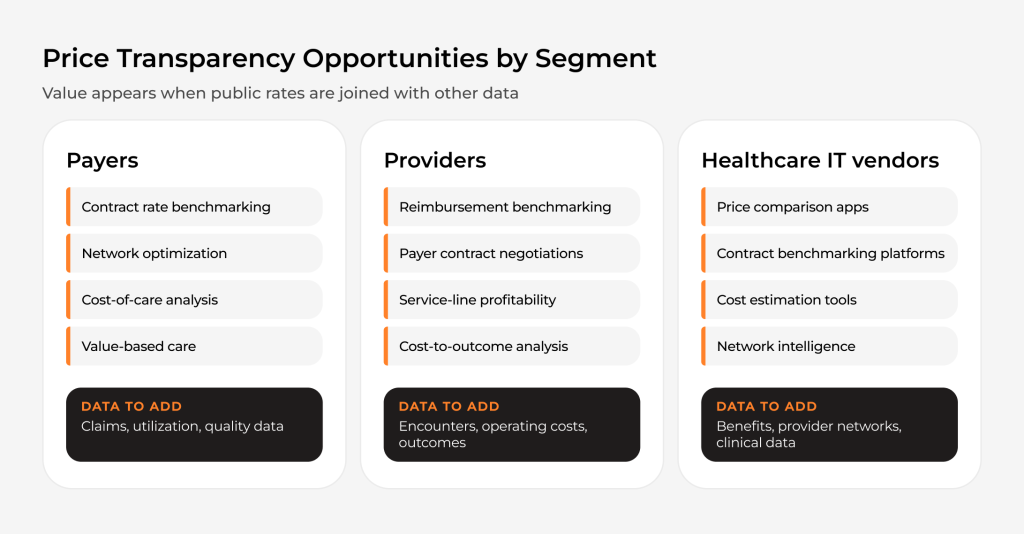
Better pricing data creates different opportunities across the market. The value appears when pricing connects to other data and supports a specific decision.
A rate file on its own answers very few questions.
For Payers: From Mandatory Disclosures to Cost and Network Optimization
Payers already hold most of the data needed to turn disclosure into payer analytics. Competitors’ public files provide additional market visibility.
Business Opportunities:
- Contract rate benchmarking. Compare negotiated rates for equivalent services across providers and geographic markets, including against competitors’ published rates.
- Network optimization. Identify providers offering comparable services at different prices and evaluate options for improving network cost efficiency.
- Cost-of-care analysis. Combine negotiated rates with claims and utilization data to find the services and providers that drive the largest share of spending.
- Provider performance analysis. Evaluate reimbursement rates alongside clinical outcomes and quality indicators.
- Value-based care. Use financial and clinical data to test whether higher spending produces better patient outcomes.
How Kodjin contributes. Kodjin Analytics can bring pricing information, claims, utilization, clinical and operational data from multiple systems into one model, whether or not the source systems use FHIR. Payers can then analyze healthcare spending in context, with negotiated rates as one input among several.
Example analytical question: Which providers deliver comparable outcomes for patients with the same condition, and how do their costs differ?
Negotiated rates alone cannot answer this question. Claims show what was billed and paid. Clinical and outcomes data define which patients are comparable and how their treatment went.
For Healthcare Providers: Reimbursement Benchmarking and Financial Performance
Hospitals publish their own prices under a separate rule. Payer files show something hospital files cannot: what competitors are paid by the same payers.
For contracting teams, this is one of the most useful public datasets available.
Business Opportunities:
- Reimbursement benchmarking. Compare contracted rates with those disclosed for other providers in the same market.
- Payer contract negotiations. Identify services where reimbursement differs substantially from relevant market benchmarks, and bring that evidence to the negotiation.
- Service-line profitability. Analyze reimbursement alongside actual treatment costs and resource use.
- Revenue optimization. Identify procedures or patient populations with unfavorable financial performance.
- Cost-to-outcome analysis. Evaluate the financial and clinical performance of different treatment approaches.
How Kodjin contributes. Kodjin Analytics can integrate pricing data with clinical encounters, procedures, claims and operational costs, even when these datasets come from systems with different formats and data models. Reimbursement analytics then goes further than rate comparison: providers see which services create value and where margins shrink. They can also trace how treatment decisions affect financial results.
Example analytical question: Which procedures have reimbursement rates below comparable market benchmarks, and how does this affect profitability across our facilities?
For Healthcare IT Vendors: New Products Built on Price Transparency Data
CMS Administrator Mehmet Oz predicted “an explosion of independent, innovative price transparency applications” once the data is standardized. Smaller, network-level JSON files with explicit context lower the cost of entry for vendors considerably.
Potential Products:
- Healthcare price transparency platforms. Collect, normalize, validate, and analyze published hospital and payer pricing data, including negotiated rates
- Contract benchmarking platforms. Help payers and providers evaluate reimbursement agreements.
- Healthcare cost estimation tools. Combine pricing data with benefit information to estimate patient expenses.
- Revenue cycle & underpayment analytics. Compares expected reimbursement against actual payments to identify underpayments, denials, and revenue leakage.
- AI-powered healthcare pricing intelligence. Let users explore pricing and reimbursement data using natural-language questions and governed analytics.
- Healthcare cost & utilization analytics. Combine pricing, claims, and clinical data to analyze cost drivers, service utilization, and variations in care.
How Kodjin contributes. Kodjin provides a healthcare data and analytics foundation that supports FHIR and non-FHIR data, so vendors can build healthcare pricing analytics software without first developing the entire data infrastructure. Its capabilities cover ingestion, transformation, terminology management, healthcare data modeling, semantic modeling, and analytics. FHIR interoperability is available as an additional capability in the Kodjin ecosystem, and Kodjin Analytics works without it.
Example product opportunity. A healthcare IT vendor develops a reimbursement intelligence platform that compares negotiated rates and combines them with clinical and financial performance indicators.
The vendor uses Kodjin to integrate heterogeneous data sources and develop analytical capabilities, so it does not have to build that infrastructure itself. Its own team then focuses on pricing-specific functionality and the user experience, where the product can differentiate itself.
Use-Case Matrix: Payers, Providers, and Healthcare IT Vendors
| Use Case | Payers | Providers | Healthcare IT Vendors | Data Needed Beyond Public Rate Files |
| Healthcare price benchmarking | Compare own rates with competitors’ by market | Compare reimbursement with peers by payer | Offer benchmarking as a product | Provider network data, code normalization |
| Network optimization | Redesign networks around cost and quality | Assess position within payer networks | Network intelligence tools | Claims, quality measures, Utilization Files |
| Cost-of-care analytics | Find spending drivers | Measure service-line margins | Financial analytics products | Claims, cost accounting, clinical data |
| Cost estimation | Member-facing estimates, phone support | Patient estimates before care | Consumer and employer tools | Benefit design, accumulators |
| Outcomes and value analysis | Value-based contracts | Cost-to-outcome comparison | Value-based care analytics | Clinical records, outcomes, risk adjustment |
Wrapping Up
The CMS price transparency rules 2026 move the industry from publishing large volumes of pricing data toward publishing data that can be trusted, compared, and used.
Payers have firm dates, starting with the first quarterly files due on April 1, 2027, and a named executive will sign off on every release. Providers and vendors get cleaner inputs for benchmarking and new products.
The organizations that benefit most will build compliance on a reusable foundation, where pricing data is integrated and governed once and then also feeds analytics.
Kodjin Data Platform and Kodjin Analytics are designed for that kind of foundation. Our team can help configure them for your specific CMS workflows and the analytics you want to run next.
CMS Price Transparency Rules 2026: Frequently Asked Questions
What are the 2026 CMS Transparency in Coverage rule changes?
The 2026 CMS Transparency in Coverage rules (CMS-9882-F) require one In-network Rate File per provider network and exclusion of rates for services a provider is unlikely to perform. Files move from monthly to quarterly updates in a single JSON format. New Taxonomy and Utilization files, along with a plain-text index, explain and locate the data. A named executive must attest to its accuracy, and members can request personalized cost-sharing estimates by phone.
Who must comply with CMS-9882-F?
CMS-9882-F applies to non-grandfathered group health plans and health insurance issuers in the group and individual markets. Third-party administrators and IT vendors often do the technical work, but the legal obligation stays with the plan or issuer. A self-insured plan remains liable if its TPA fails to comply, while an insured plan can shift responsibility to its issuer by written agreement.
What are the CMS price transparency deadlines for 2027 and 2028?
The first quarterly In-network Rate and Allowed Amount files under the new rules are due April 1, 2027, with requirements applicable from March 6, 2027. Taxonomy and text files follow on October 1, 2027. The new Prescription Drug File starts in December 2027, and the first annual Utilization File is due July 1, 2028.
What machine-readable pricing files do health plans need to publish?
Health plans need to publish an In-network Rate File for each provider network, and Out-of-network Allowed Amount Files, plus a Prescription Drug File. Under the 2026 rules, they also publish two contextual files, the Taxonomy File and the Utilization File. A plain-text file in the website root lists where all machine-readable files are located.
How do the Transparency in Coverage rules differ from Hospital Price Transparency?
The Transparency in Coverage rules apply to health plans and insurers and are enforced by the Departments of Labor, HHS, and the Treasury, along with state regulators. Hospital Price Transparency (45 CFR Part 180) applies to hospitals instead. It uses its own file template, and its penalties follow a bed-based formula of up to $5,500 per day.
Why are negotiated rates difficult to compare across providers and networks?
Negotiated rates are difficult to compare because the same service can carry different rates by network and product type, and older files often omitted that context. Duplicate records and missing provider identifiers add noise, while non-standard codes make matching harder for healthcare price transparency analytics. Rates therefore need normalization before any comparison, which is the kind of preparation a healthcare data platform like Kodjin is built to handle.
Can healthcare pricing data be combined with claims and clinical data?
Yes, healthcare pricing data can be combined with claims and clinical data once provider identifiers and billing codes are aligned and the time periods match. The combination supports cost-of-care analysis and provider performance evaluation. It is also the basis for value-based care modeling, which negotiated rates alone cannot support.
How can a healthcare data platform support CMS price transparency workflows?
A healthcare data platform supports CMS price transparency workflows by ingesting rates from contract and claims systems and normalizing codes and provider network data. The results are kept as governed, versioned datasets. File generation and validation against CMS schemas then run on top of those datasets, which can also feed analytics. Kodjin Data Platform provides this foundation, with CMS-specific workflows configured for each organization.
Does CMS require FHIR for price transparency machine-readable files?
No, CMS does not require FHIR for Transparency in Coverage machine-readable files. The Department specifies JSON, defined by CMS schemas on GitHub, for all files except the text file, which must be plain text. FHIR remains useful when pricing data needs to be linked with clinical records.
What can payers and healthtech vendors build using public pricing data?
Payers and healthtech vendors can build contract benchmarking tools, network optimization analytics, cost estimation applications, and reimbursement intelligence products from public pricing data. The most useful products join public rates with claims and provider network data and, increasingly, with clinical outcomes. Vendors can use Kodjin as the data and analytics layer and focus their own effort on the product experience.