Industry: Healthcare
Country: US
Project type: Analytics Platform
Duration: Ongoing
Kodjin Analytics helps U.S. healthcare organizations connect clinical, operational, and financial data, track quality metrics in real time, and measure the ROI of value-based contracts. The value-based care solution is a part of the broader Kodjin Analytics platform.
Designed for:
CMOs & Quality Directors VPs of Clinical Operations ACO & Health System Leaders Payer & Managed Care Teams Healthtech Product OwnersMost value-based care (VBC) software is sold as a large turnkey enterprise suite, with separate applications for care management, cost analysis, and quality metrics.
Where it falls short:
The result:
Slow reporting, high costs, and no clear line between clinical outcomes and the money at stake in risk-based contracts.
Kodjin Analytics gives U.S. organizations what most value-based care software doesn’t: one flexible data foundation with a single AI-assisted analytics product on top, covering quality, cost, care gap, and reporting work.
With Kodjin Analytics, you can:
Most value-based care software comes as separate applications bundled into one expensive enterprise contract. Kodjin gives you a single, flexible value-based care data analytics product that handles quality, cost, and care management on the same data.

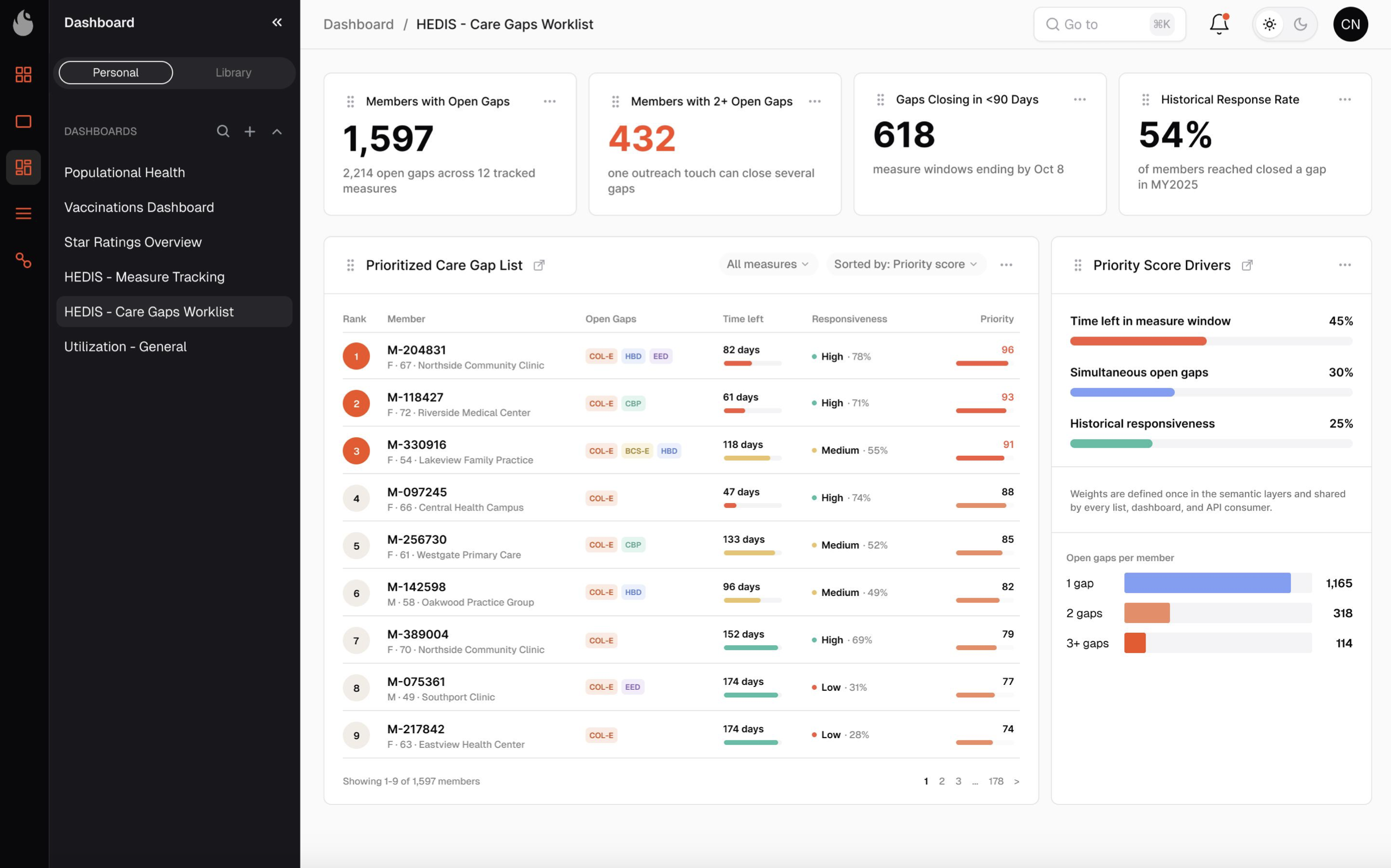
Identify screening and follow-up gaps before the measurement period closes. Kodjin brings clinical data together so you can track quality indicators across programs and sites, compare performance against targets, and focus improvement efforts where they affect quality scores and value-based incentives.

See where quality performance stands during the year, not after it closes. Kodjin’s VBC analytics software tracks configurable quality indicators aligned with HEDIS®, CMS Star Ratings, and MIPS from FHIR and other formats, so your team can tell real care gaps from missing data while there’s still time to close them.

Reduce avoidable utilization with one consistent view across facilities. Spot high-volume services, resource overuse, and care variation, and use those findings to target care management programs before costs escalate.

Track quality, utilization, and cost across MSSP and other value-based contracts on one flexible foundation rather than a stack of solutions. Connect clinical outcomes to financial performance and see how shared-savings results are trending during the year.

Bring clinical and claims data together to evaluate network performance, manage financial risk, and give every client value-based analytics they can rely on across contracts, populations, and care programs.

Embed value-based care analytics directly into your product. Kodjin’s API and prebuilt components deliver VBC quality and cost insights, with every metric calculated the same way across your product, so you don’t have to build analytics infrastructure from scratch.
CMS reported that 75% of the 476 Medicare Shared Savings Program ACOs earned performance payments totaling $4.1 billion, while net savings to Medicare reached $2.5 billion.
Shared savings depend on meeting quality standards, but retrospective reporting shows where you stand only after the period closes. Kodjin’s VBC analytics software continuously tracks configurable quality indicators aligned with HEDIS®, CMS Star Ratings, and MIPS from live data, so teams see current performance and spot open gaps as they arise. New indicators can be added through configuration, so teams keep up as reporting requirements change.
More time to close gaps, stronger quality scores, and better protection of incentive payments.

The 2024 CMS National Health Expenditure data shows that U.S. healthcare spending reached $5.3 trillion, with hospital care accounting for $1.6 trillion.
Controlling costs under value-based contracts means knowing which clinical decisions, utilization patterns, and outcomes drive spending. With Kodjin’s value-based care data analytics, financial and clinical leaders work from the same data: high-cost patients, avoidable utilization, and episode-level variation appear alongside the clinical context behind them.
A clear view of what drives total cost of care, a stronger position for earning shared savings, and a defensible view of contract ROI.

CMS quality results for performance year 2024 show how much is still at stake in common care gaps. Among Shared Savings Program ACOs reporting all-payer MIPS CQMs, average blood pressure control improved from 69.63% to 73.65% and poor HbA1c control fell from 35.18% to 23.52%, yet roughly one in four patients still falls short on each measure.
Kodjin Analytics helps care teams ask natural-language questions, such as “What share of our diabetes population has no recorded HbA1c test in the past six months?” and act on the answer the same day. The solution then maps tests, visits, and follow-ups over time, showing where along the care pathway gaps occur instead of looking at isolated data points.
Earlier action on overdue tests and follow-ups, and care improvement efforts aimed where gaps actually occur.

CMS reported that the 2025 Shared Savings Program includes 476 ACOs, 655,725 healthcare providers and organizations, and more than 11.2 million Traditional Medicare beneficiaries.
At this scale, quality reporting cannot depend on manual spreadsheet assembly or metric logic scattered across tools. Kodjin Analytics defines each metric once in a single semantic layer, so reports stay consistent across teams. When CMS, an ACO, or a payer asks how a number was calculated, the query trail is already there.
Faster audit responses, consistent numbers across teams, and less business risk at reporting time.

Real-Time Visibility into Quality Performance

A Measurable Link Between Clinical Outcomes and Financial Results
Early Insight into Care Gaps and Utilization Patterns
Traceable Reporting for ACO, MSSP, and Payer Requirements
Get a guided walkthrough of our value-based care software, tailored to your U.S. program’s priorities: MSSP quality reporting, cost management, or care gap closure.
We’ll start from how your team tracks quality and cost today and show where Kodjin supports that work.

Effective VBC depends on connecting data that lives in different places: EHRs, claims, quality registries, cost feeds, and social determinants of health (SDOH). Kodjin connects these sources in one data foundation, and its semantic layer gives every measure and report the same definitions.
What Kodjin Analytics Does
What This Means for Value-Based Care Teams
Unifies clinical and financial data from EHRs, claims, and registries
An integrated view of clinical outcomes and costs
Tracks quality indicators natively from FHIR and other data formats
Year-round value-based care monitoring of indicators aligned with HEDIS®, CMS Star Ratings, and MIPS
Structures data around standard clinical terminologies
Diagnoses and lab results coded differently across EHRs are still recognized as the same condition or test
Exposes value-based analytics via one API
Embed VBC insights into your product, portal, or workflow without building your own BI stack
Keeps metrics consistent across teams
Quality, financial, and care management teams stop reconciling conflicting reports
Processes data in real time
Care gaps and cost spikes show up as soon as new data arrives, not weeks later in a report
Value-based care is one of several ways to use Kodjin Analytics. The same data analytics foundation also supports cost analysis, care management, and research, so you’re not buying separate tools for each initiative.
Explore related use cases:
Kodjin gives VBC programs a single platform that tracks quality indicators aligned with HEDIS®, CMS Star Ratings, and MIPS in real time. Instead of waiting for a retrospective extract, quality teams see current numerators, denominators, and exclusions and close gaps before the period ends. Every measure runs on the same semantic layer, so quality, financial, and care management teams all see the same numbers. That consistency is what U.S. shared-savings reporting needs from value-based analytics.
FHIR keeps the relationships between conditions, medications, encounters, and observations intact, unlike flat data extracts. Because Kodjin is FHIR-native, FHIR value-based care data keeps that structure from ingestion through analysis. That lets the platform track quality indicators, surface care gaps, and link clinical outcomes to financial performance without building a new data pipeline for each question.
Yes. Kodjin supports MSSP and other U.S. value-based programs tied to incentive payments. It brings clinical and claims data into one integrated foundation, and its API delivers quality and cost results directly to your reporting workflows. Teams can compare performance against program or contract targets and review the query logic behind every number. Integration is set up around each receiving system’s data and submission requirements.
Kodjin continuously evaluates your population against quality criteria, so open gaps are visible the moment they appear. Care teams can ask in plain language which patients are overdue for a screening or follow-up and get the list from current data. Gap closure becomes part of the daily routine instead of a year-end scramble.
Kodjin’s VBC analytics software tracks quality indicators aligned with HEDIS®, CMS Star Ratings, and MIPS. It doesn’t replace official reporting: HEDIS rates come from NCQA-certified tools, and Star Ratings and MIPS scores from CMS. Kodjin is the solution for tracking performance during the year, when results can still be improved.
Please leave your email to get Kodjin Analytics Solution Brief
We have sent a copy to your email
Please leave your email to get Kodjin Data Platform Solution Brief
We have sent a copy to your email
Back to website content